
Article
Utilities leverage key performance indicators to evolve
Aug. 25, 2016
Key performance indicators (KPIs) are activity and profitability measures used as management tools by many industries including utilities. KPIs are used primarily to set baseline performance measures and then implement strategies for improved performance on those baselines. Measures are derived from evaluation of internal performance and also comparisons to external performance by peers using analytics of external reports or industry publications. A key tool in implementing various strategies, KPIs also measure the success or failure of initiatives for utilities.
What should be measured?
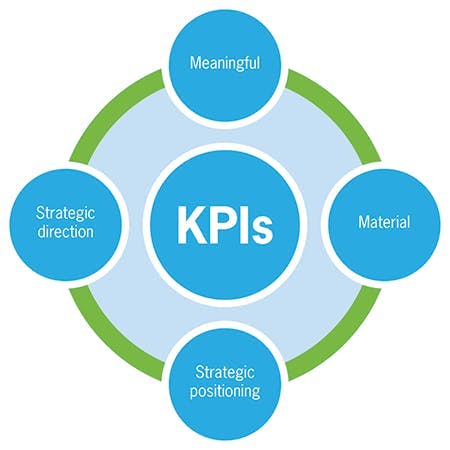
Effective KPIs meet these criteria:
- Be meaningful to support managerial decision making
- Concentrate on the most material financial and non-financial issues
- Assist with external assessment of the organization’s strategic positioning in the industry
- Align with the organization’s strategic direction
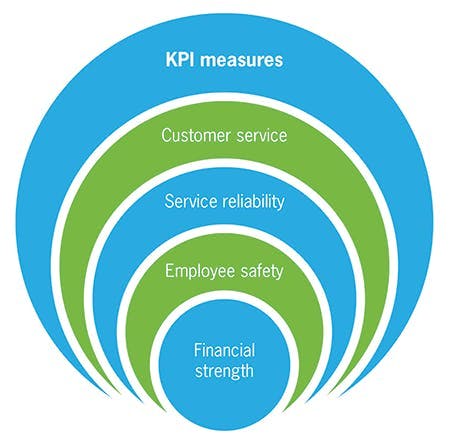
KPIs used in utilities generally fall into these primary areas:
- Impact of activities to serve customers
- Reliability of service
- Safety of employees in service delivery
- Financial strength
Data sources
The first KPI review should be of the utility’s own operations. After this evaluation, reliable sources of utility KPI data can measure one’s internal operations against industry peers including:
- American Public Power Association
- Edison Electric Institute
- American Waterworks Association
- Water Research Foundation
- Public Service Commission of Wisconsin (water only)
In addition, industry subscription services, such as SNL Energy and Energy Central, can help assemble industry benchmarking data.
Industry trends and current measures
Strategic planning and—in the context of this article—KPIs must be stratified to measure current operations, short-term industry changes, and long-term trends.
Current operations
Current operations cover the budget cycle or future operations over a maximum period of three to five years. The KPIs listed below are a small sample of common measures and possibilities.
Short-term financial KPIs
- Liquidity (days unrestricted cash on hand)
- Debt service coverage
- Return on rate base
- Leverage (capitalization – ratio of debt and equity)
- Cost of capital
- Unrestricted cash flows
Customer service and operational financial KPIs
- Customers per employee
- Operation and maintenance expenses per customer
- Power supply expense per kWh
- Distribution operation and maintenance expenses per customer
- Customer costs per customer
- Operation and maintenance expenses per kWh sold
- Power supply expense per kWh sold
- Retail customers per meter reader
- Distribution operation and maintenance expenses per distribution mile
- Administrative and general expenses per customer
Operational, safety, and reliability KPIs
- Labor expenses per labor hour
- OSHA incident rate per worker hour
- System load factor
- Average number of years to retirement by employee by department
- Renewable energy portfolio mix of power supply
- Reliability (SAIDI, CAIDI, SAIFI)
- Energy loss percentage
- Average age per employee by department
- Full time equivalent employees per department
- Renewable energy power output capacity
Materials management KPIs
- Inventory turnover
- Purchase order cycle time
- Inventory carrying costs
- Inventory months of supply
- Line count fill rate
- Inventory activity based on placement in inventory storage
To determine the KPIs meaningful for your utility, assemble department heads, line managers, and employees to discuss areas that should be measured and slated for improvements as well as where KPIs can assist in process improvement and which could impact compensation plans.
Industry trends and the utility of tomorrow
KPIs are an integral part of strategic planning and strategy implementation. The utility should also consider "Are these KPIs helping measure progress of our strategy implementation?" and "Are these effective measures for tomorrow’s utility?”
The continued evolution of the utility business and service delivery almost guarantees the utility of tomorrow will look much different than today. Think of the impact of Amazon; first on the business of selling commodities like books in brick-and-mortar stores to now being able to buy almost any item online. As electricity becomes more of a commodity and less of a monopoly, what might happen?
Over the next five to twenty years, experts indicate trends will continue to accelerate in these areas:
- Succession planning as generational changes take place in management and operational personnel
- Convergence of electric and broadband delivery
- Integration of broadband and electric delivery through use of smart meter technology
- Increasing regulation on fuel types and renewable energy requirements
- Increasing regulation on emissions
Some KPIs are used to measure these trends now and others will be developed.
Utility business in fifty years
As technology improves and current (and not so current) ideas come to fruition, the utility of tomorrow may deliver electricity without wires.[1] In fact, Japan and China have preliminary plans to experiment with power satellites in the 2030s.[2] What will this do to cost recovery of existing infrastructure and investments in infrastructure being made today? Also, when the issues with electricity storage and battery storage are solved, the customer base of the traditional monopoly utility will change.
As the use of solar and wind becomes more affordable and prevalent, utilities may see changes in service delivery and rate recovery. Customers will be able to generate and store their own supply of electricity. Consider these impacts:
- A utility's monopoly power will weaken even in states without open retail access for electric customers
- A shrinking customer base will need to pay for the utility's infrastructure investments
- Utilities can expect continued pushback on net metering caps
- “Availability of use standard” will lose meaning as customers will not require it due to being able to meet their own needs
Summary
The utility business, essential to society, will come full circle. Their existence will rely on retaining customers by providing superior reliable service at a reasonable price. New KPIs will be developed to measure progress towards the goals of the utility of tomorrow. For today’s utility, many useful measures are common in the industry.
For more information on this topic, or to learn how Baker Tilly energy and utility specialists can help, contact our team.
[1] Free Energy for Spaceship Earth Energy for the 21st Century and Beyond, Telsa Power Tower
[2] The Race for Space Solar Energy, thepeoplesvoice.org, March 26, 2011
Related sections
Article Tags
