What governs how it’s completed?
The standard-setting body that governs Single Audits in the United States is the Office of Management and Budget (OMB). The OMB issues the Compliance Supplement that auditors use to conduct Single Audits. Single Audits are required for non-federal entities (NFEs) that expend more than $750,000 of federal dollars within their fiscal year. An NFE means a state, local government, Indian Tribe, Institution of Higher Education (IHE), or not-for-profit organization that carries out a federal award as a recipient or subrecipient. Recently, OMB proposed revisions to the Uniform Guidance, most notably to raise the Single Audit threshold from $750,000 in federal awards expended within a fiscal year to $1 million, the first increase in the Single Audit threshold since 2013.
Types of findings
Audit findings can be categorized as a Financial Statement finding or a Compliance finding:
Financial statement
A financial statement finding relates to accounting controls or the accounting assumptions used to prepare the accounting records. These findings represent departures from GAAP or deficiencies in the internal controls designed to ensure the financial statements fairly present your organization’s financial condition.
Compliance
A compliance finding is related to noncompliance with federal laws, statutes, regulations, and program terms and conditions, or deficiencies in the internal control over compliance designed to ensure the organization complies with such provisions. This type of finding is specific to an individual compliance issue for a major program.
Financial statement and compliance concerns must be evaluated and categorized into one of three categories: a control deficiency, significant deficiency, or material weakness.
Control deficiency
The design or operation of a control over financial reporting or compliance doesn’t allow management or employees to prevent, or detect and correct, misstatements or noncompliance on a timely basis. A control deficiency is less severe than a significant deficiency.
- Design deficiency. A control necessary to meet the control objective is missing, or an existing control isn’t properly designed so that, even if the control operates as designed, the control objective wouldn’t be met.
- Operation deficiency. A properly designed control doesn’t operate as designed or the person performing the control doesn’t possess the necessary authority or competence to perform the control effectively.
Significant deficiency
A deficiency, or combination of deficiencies, that is less severe than a material weakness, yet important enough to merit attention by management.
Material weakness
A deficiency, or a combination of deficiencies, exists in internal control for either financial reporting or compliance, such that there’s a reasonable possibility that a material misstatement of the entity’s financial statements or material noncompliance won’t be prevented, or detected and corrected, on a timely basis.
Material weaknesses and significant deficiencies in internal control over financial reporting or over compliance must be reported as part of the financial statements or Single Audit report. Internal control or noncompliance concerns not categorized as a material weakness or significant deficiency can be communicated in a separate management letter to the auditee.
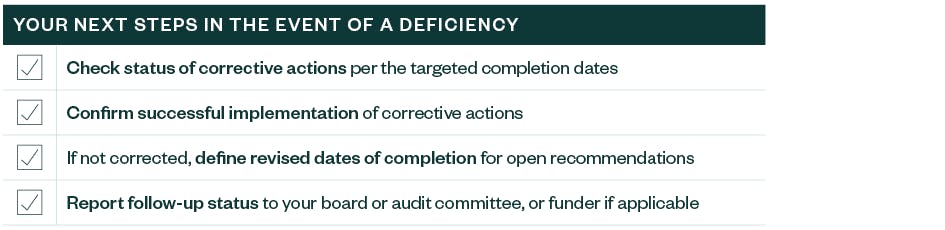
Next steps checklist
What will your single audit look like?
Each Single Audit is different, so it’s important to discuss with the auditor what to expect, what should occur, your responsibilities, and the specific duties of the auditor. Cover this in your engagement letter.
Factors that influence what occurs during the audit include the complexity of your organization and the availability and completeness of the documentation supporting the internal control system, financial statements, and program activities and expenditures.

