Which cybersecurity frameworks make sense for your organization?
The right cybersecurity frameworks depend on your business model, the information you manage, your customers, and the markets you serve.
Some requirements are legally mandated or contractually required. Others provide independent assurance that can strengthen customer confidence or support sales opportunities.
Common cybersecurity frameworks and requirements
- System and Organization Controls (SOC) 2 provides independent assurance over relevant controls at service organizations. Enterprise customers frequently request SOC 2 reports when evaluating technology and software-as-a-service (SaaS) providers.
- International Organization for Standardization (ISO) 27001 establishes requirements for an information security management system. Certification may be valuable for businesses expanding internationally or serving customers that expect globally recognized security standards.
- HITRUST offers a standardized assurance approach used frequently in healthcare and other regulated industries. Customers handling sensitive healthcare information may request HITRUST certification.
- Health Insurance Portability and Accountability Act (HIPAA) requirements apply to covered entities and business associates handling protected health information.
- Payment Card Industry Data Security Standard (PCI DSS) requirements apply to entities that store, process, or transmit payment account data, as well as certain systems that can affect the security of the cardholder data environment.
- FedRAMP provides a standardized security assessment and authorization approach for cloud services used by federal agencies.
Organizations may need several of these frameworks because each serves a different purpose.
Consider a healthcare technology company that handles protected health information, serves large hospital networks, and wants to expand internationally. HIPAA requirements may apply because of the data it handles, while customers may request HITRUST or SOC 2 assurance. ISO 27001 certification could also support international expansion.
Before pursuing another framework, evaluate whether customer demand, regulatory obligations, or a defined business opportunity justify the investment.
The cost assessment needs to account for technology changes, internal personnel, outside advisors, assessment fees, and ongoing maintenance.
Where can cybersecurity compliance frameworks share controls and evidence?
Many cybersecurity frameworks address similar security practices, including access management, risk assessments, incident response, personnel security, and third-party risk management.
This overlap creates opportunities to use common controls and evidence across multiple compliance requirements.
For example, a company may maintain one process for employee onboarding and offboarding, with consistent controls governing system access. Evidence from that process could support several assessments if it meets each framework's applicable requirements.
Compliance activities that may support multiple frameworks
- Reviewing user access permissions
- Maintaining security policies and procedures
- Documenting authentication configurations
- Evaluating cybersecurity risks
- Managing employee access when roles change
- Monitoring third-party security requirements
Framework mapping helps identify these relationships by connecting similar requirements to common controls.
Resources such as the Secure Controls Framework and HITRUST's control mappings can support this work. Governance, risk, and compliance (GRC) platforms may also help organizations organize requirements and collect evidence.
However, mapping similar requirements doesn't establish that one control satisfies every applicable standard. Each framework may evaluate a different system, data population, period, or control parameter.
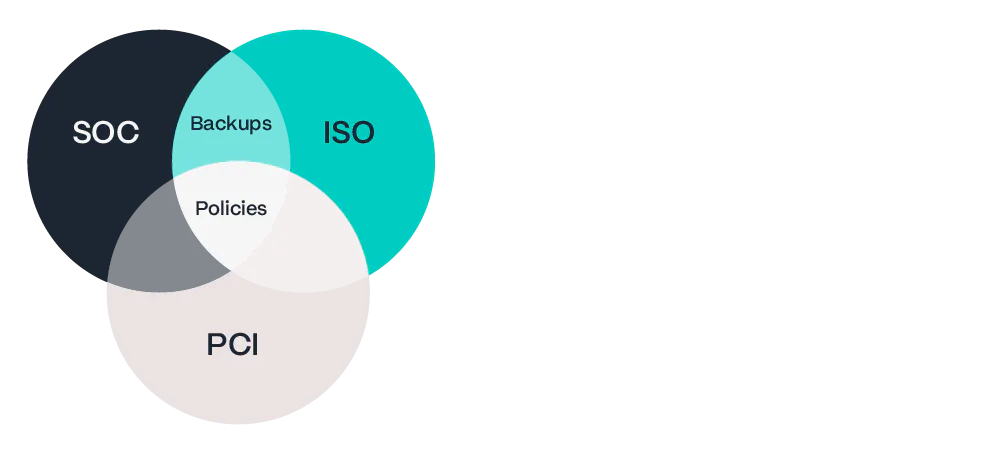
Organizations need to verify the applicability of each requirement before relying on shared controls or evidence.
What makes integrating multiple compliance frameworks challenging?
Even when frameworks address similar security practices, their assessment approaches can differ substantially.
PCI DSS focuses heavily on protecting payment account data and the systems that affect its security. ISO 27001 evaluates an organization's information security management system. SOC 2 examines controls relevant to a defined service organization's system.
Those differences influence how organizations establish scope, document controls, and prepare for assessments.
Differences that affect compliance assessments
- Frameworks may cover different systems, applications, business units, or data populations.
- Similar controls can have different technical standards or implementation expectations.
- Reporting periods, certification cycles, and ongoing monitoring requirements may not align.
- Assessors may use different testing methods, sampling approaches, and documentation requirements.
- Organizations with multiple products or acquired businesses may need separate assessments for certain environments.
Password requirements offer a useful example.
An ISO 27001 assessment may evaluate authentication controls against the organization's policies and risk management approach. A SOC 2 assessment may examine whether implemented controls meet the commitments and criteria described in the engagement. PCI DSS contains more prescriptive authentication requirements.
A password configuration that satisfies one assessment may require additional testing or changes to satisfy another.
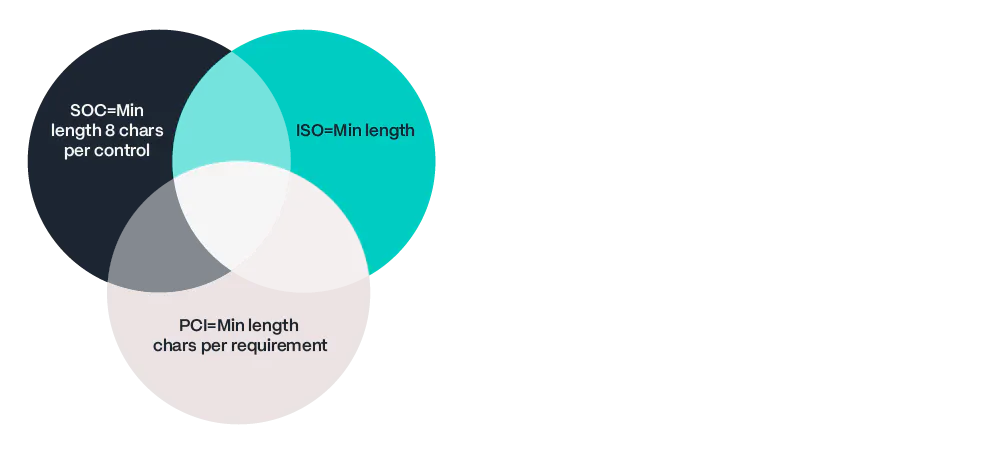
Identifying these differences early helps organizations establish controls that address multiple requirements where practical, while accounting for framework-specific obligations.
How can you create a more efficient cybersecurity audit process?
Coordinating assessment activities can reduce repeated evidence requests and the operational burden on control owners.
Organizations often conduct separate audits at different times, even when those assessments examine many of the same systems and controls. That approach can require employees to provide similar documentation and participate in repeated walkthroughs.
A more coordinated process identifies shared testing opportunities, assigns control ownership, and schedules assessment activities with resource availability in mind.
For example, a SaaS company pursuing SOC 2 and ISO 27001 may coordinate portions of those assessments to reuse relevant evidence and walkthroughs.
If PCI DSS requirements also apply, the company might schedule that assessment later in the year. This could allow the assessment team to reuse applicable evidence while giving internal personnel more time to support each engagement.
Successful coordination requires attention to different assessment methods and reporting schedules. Some activities can occur together, while other testing must remain separate.
A shared compliance calendar can help teams anticipate requests, coordinate responsibilities, and reduce interruptions to day-to-day operations.
When does a GRC platform make sense?
GRC platforms can help organizations manage controls, assign responsibilities, track requirements, and organize audit evidence across multiple frameworks.
These capabilities become more valuable as a business adds products, enters regulated markets, or faces more complex customer expectations.
However, purchasing a GRC platform isn't a prerequisite for every compliance program.
A smaller organization pursuing its first SOC 2 report may be able to manage its controls and evidence through existing processes or tools available from its assessment provider, particularly when employees already understand the requirements.
As compliance obligations grow, those processes may become difficult to maintain.
Before investing in a platform, consider the organization's current expertise, number of applicable frameworks, assessment frequency, and available budget.
The technology also needs to fit the maturity of the compliance program. An early-stage company with rapidly changing systems may benefit from mapping requirements without immediately developing a comprehensive unified control framework.
As its control environment stabilizes, consolidating common controls into a unified library may become more practical.
A GRC platform can support these activities, but effective compliance still depends on accurate scoping, clear ownership, and consistent execution.
How can a compliance roadmap evolve as your business grows?
A cybersecurity compliance roadmap needs to evolve alongside business strategy, customer requirements, and the organization's control environment.
Consider a financial services SaaS company that began with a SOC 2 Type 1 report to meet customer expectations.
As the business expanded, it pursued a SOC 2 Type 2 report and ISO 27001 certification to support international opportunities. The organization coordinated assessment activities to reuse controls and evidence where possible.
Later, it added PCI DSS requirements, scheduling related assessment activities after its existing audit work to reduce pressure on its internal compliance team.
As the program matured, the company replaced its original GRC platform with a solution better suited to managing multiple frameworks and a coordinated audit schedule.
The organization then began evaluating additional compliance investments associated with potential healthcare and government customers.
Each decision reflected changing business priorities rather than a fixed plan to pursue every available framework.
That approach also creates opportunities to reconsider existing investments. If an organization exits a market or changes its product strategy, leadership can reassess the value of certifications and assurance activities that no longer support its objectives, subject to applicable obligations.
For smaller businesses, the financial considerations may be particularly significant. Some prospective customers may be willing to enter into agreements while a company completes a required compliance program, potentially helping fund the investment. Whether that's feasible depends on the customer's requirements and the commercial relationship.
A practical roadmap connects compliance planning to upcoming business decisions. Regular reviews can help leadership identify new requirements, reassess costs, and coordinate activities as the organization changes.
As cybersecurity expectations continue to evolve, organizations that treat compliance as part of business planning can make more informed investments, reduce duplicate work, and pursue growth opportunities with greater confidence.


