
Article
IRS releases guidance on new foreign income tax allocation under OBBBA
Dec. 19, 2025 · Authored by James C. Lawson and Nikki Grams
The IRS and Treasury recently issued Notice 2025-72, delivering critical guidance on the One Big Beautiful Bill Act’s (OBBBA) repeal of the one-month deferral election under section 898. The guidance offers relief in providing for the allocation of foreign income taxes of affected foreign corporations between a one-month short period and the succeeding taxable year, thereby mitigating the potential loss of foreign tax credit. The Notice also clarifies how the amortization election made with respect to any section 987 pretransition gain or loss will be impacted as a result of short taxable periods (including that for the first required year upon loss of the one-month deferral previously elected under section 898).
Removal of the one-month deferral election under section 898
Section 898 generally requires controlled foreign corporations (CFCs) to conform their U.S. taxable year to that of their majority U.S. shareholder unless the requirements for an exception have been met. Historically, taxpayers for which conformity is required could elect to use a taxable year beginning one month earlier than the required taxable year. The OBBBA removes the one-month deferral election, and, as a result, forces taxpayers that own specified foreign corporations (e.g., CFCs) for which the one-month deferral election had been made, to report a one-month short taxable year for applicable CFCs for each’s first taxable year beginning after Nov. 30, 2025. This means that an accrual basis specified foreign corporation, or CFC, electing, for example, to use a Nov. 30 year-end, when the required year-end is Dec. 31, (an affected corporation) will result in the filing of two Forms 5471 for the U.S. shareholder’s 2025 taxable year: one for the period of Dec. 1, 2024, through Nov. 30, 2025, and a second for Dec. 1, 2025, through Dec. 31, 2025. For more on the removal of the one-month deferral election and other OBBBA changes impacting CFCs, please refer to this article explaining the revamp and rebrand of the GILTI regime in the One Big Beautiful Bill Act.
For foreign tax credit purposes, accrual basis taxpayers generally consider qualifying foreign income taxes once they are first fixed and determinable under the all-events test, which is generally at the end of the foreign taxable year to which such taxes relate. This can create foreign tax creditability issues in a one-month short period (such as that imposed above) in which a full year of income taxes accrue and might otherwise be creditable (e.g., a CFC’s entire tax liability for the foreign taxable year of Jan. 1, 2025, through Dec. 31, 2025) but only one month of the corresponding CFC income is includible (e.g., for the December 2025 one-month period).
As a result, affected corporations could have losses for the one-month short period in one or more income groups after allocating and apportioning foreign income taxes to each income group. In the absence of any subpart F and/or global intangible low-taxed income (GILTI) deemed inclusion amounts to the U.S. shareholder with respect to the affected corporation for the one-month short period (e.g., loss resulting from the allocation and apportionment of foreign income taxes to the respective income groups), any foreign income tax so allocated or apportioned would not be considered as foreign income taxes deemed paid by the U.S. shareholder for foreign tax credit purposes. This in turn might effectively result in a double taxation of corresponding CFC income attributable to the 11-month period immediately preceding the one-month short period which had previously been subject to U.S. taxation on the U.S. shareholder’s prior year’s tax return but for which attributable foreign income taxes separately imposed on that income lost as potential foreign tax credit in the absence of any relief provided to the contrary.
As foreshadowed in 2025 Year-end tax considerations for international tax planning, critical guidance was needed to properly address this issue, which has arrived in the form of Notice 2025-72. Notice 2025-72 is the first of four notices providing needed interim guidance regarding OBBBA changes to various international provisions. Notice 2025-72 promises regulations on point as well as sets forth an ordering rule for allocating “specified foreign income taxes.” Specified foreign income tax excludes an affected corporation’s distributive share of foreign income taxes paid or accrued by a partnership and withholding taxes. The allocation of specified foreign income tax between the required short period (“first required year”) and the “succeeding taxable year,” is described as follows:
- The specified foreign income tax amount is determined
- The specified foreign income tax is allocated and apportioned to income or previously taxed earnings and profits (PTEP) groups
- The amount of specified foreign income tax in each income group allocated between the first required year and the succeeding taxable year is determined under the allocation rule
- The amount of specified foreign income tax allocated to each period under step three is treated as accruing in each respective year for most purposes of the code. Taxes allocated to the succeeding taxable year are treated as having accrued for purposes of foreign tax credit redeterminations under section 905(c) and for translating foreign income taxes under section 986(a) in the first required year in which incurred
With regards to the third step, the amount of specified foreign income tax that is allocated to the first required year is determined first and is calculated as follows:
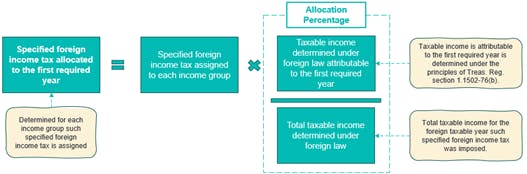
Any specified foreign income tax assigned to a PTEP group is allocated to the first required year and the related foreign-law taxable income item is excluded from determining the above allocation percentage. Specified foreign income taxes not allocated to the first required year are allocated to the succeeding taxable year. Special rules apply with regard to certain ownership or classification changes that occur on or before the start of the first required year, as well as in applying sections 905(c) and 986(a).
Section 987 transition guidance
The Notice announces forthcoming regulations under section 987 that would clarify the amortization of any section 987 pretransition gain or loss (for which an amortization election was made) for short taxable years including by reason of the removal of the one-month deferral election. Taxpayers making the amortization election would recognize any section 987 pretransition gain or loss ratably over a 120-month period starting with the year beginning on or after the transition date (e.g., Jan. 1, 2025, for in-scope calendar year filers) unless special rules related to transfers described under section 381(a) apply. The Notice specifies if a qualified business unit (QBU) owner recognized a portion of the amortizable section 987 pretransition gain or loss in a short taxable year ending before Nov. 25, 2025, the date of the Notice, such short taxable year is deemed to be 12 months to the effect that the remaining balance will be amortized ratably over the following 108-month period. For more on section 987, please refer to 2025 Year-end tax considerations for international tax planning.
Applicability dates and reliance
For guidance on the removal of the one-month deferral election under section 898, the Notice can generally be relied upon for foreign income taxes paid or accrued by specified foreign corporations for taxable years beginning after Nov. 30, 2025, and ending before the proposed regulations are published in the Federal Register. With respect to the clarifying guidance provided on amortization of section 987 pretransition gain or loss under amortization election, the Notice can be relied upon for taxable years in which the section 987 regulations apply until proposed regulations are published. Comments on rules set forth in the Notice are requested and must be submitted by Jan. 24, 2026.
If you have questions about how the above may impact your tax situation, please contact your Baker tilly tax advisor.

Related sections
The information provided here is of a general nature and is not intended to address the specific circumstances of any individual or entity. In specific circumstances, the services of a professional should be sought. Tax information, if any, contained in this communication was not intended or written to be used by any person for the purpose of avoiding penalties, nor should such information be construed as an opinion upon which any person may rely. The intended recipients of this communication and any attachments are not subject to any limitation on the disclosure of the tax treatment or tax structure of any transaction or matter that is the subject of this communication and any attachments.