
Article
Four transformative ways ERP can drive smarter, sustainable decisions
Dec. 10, 2024 · Authored by Cindy M. Bratel
Environmental, Social and Governance (ESG) criteria have become essential for the success of modern enterprises. ESG evaluates the sustainability and societal impact of businesses. Sustainability credentials have now become a key consideration for investors, consumers and other stakeholders seeking to understand the full scope of a company’s operations and long-term viability. According to MSCI, management of ESG practices can improve risk management and result in outcomes like improved customer attraction, employee retention and enhanced financial performance. There is a growing impact of ESG factors. For instance, increased public awareness of environmental challenges, such as climate change and biodiversity loss has increased the demand for corporate accountability and action.
Regulatory bodies have also begun placing emphasis on sustainability, accompanied by mandatory disclosure requirements and investment mandates, which leads to incentivizing firms to improve their ESG standing. However, the encouraged adoption of ESG practices is not without its challenges of its own. Among these is the inconsistency in reporting frameworks. Different frameworks lead to variability in how companies measure and communicate their ESG performance. Modern enterprise system’s ESG data is another important factor in reporting. Inconsistent, low-quality data also undermines trust in ESG initiatives.
How are businesses leveraging ERP systems to integrate ESG data and enhance their decision-making processes?
Enterprise resource planning (ERP) systems integrate business functions into one unified platform and help organizations streamline operations and decision-making. ERP platforms are now being leveraged by today’s companies for ESG accountability. By integrating ESG data into ERP, businesses can better track sustainability performance and goals and comply with regulations. Hence, the ability to track and combine financial, operational and sustainability data in one platform is transforming how companies approach business decisions, making it more data-driven and transparent. Explore the transformative ways in which integrating ESG with ERP helps businesses:
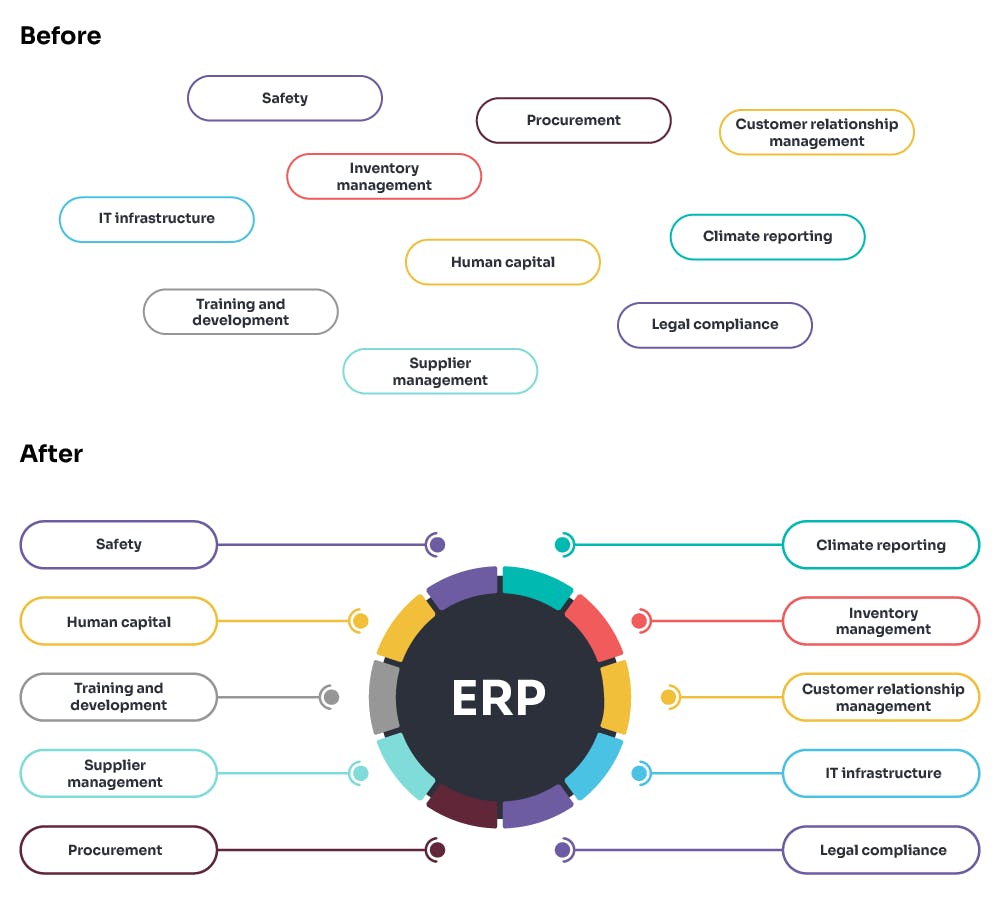
1. Enable holistic ESG data integration and achieve goals
The key benefit of controlling and tracking ESG data across ERP systems is its ability to unify data across business processes. Typically, data related to sustainability, environmental impact and social responsibility are contained in multiple systems, leading to inconsistencies and incomplete reporting. ERP platforms serve as centralized hubs for data on segments like resource consumption, energy usage, waste generation and greenhouse gas emissions. Environmental data visibility unlocks powerful opportunities for targeted action. For instance, in addition to human capital metrics such as employee headcount and training completion rates, it would be beneficial for organizations to incorporate ESG relevant data, such as employee commute data for Scope 3 emissions reporting and safety metrics in ERP systems, to enhance centralized reporting and management. Alongside the environmental dimension, ESG tracking can enhance a company’s ability to manage its social responsibilities. ERP systems are repositories for a wealth of data related to an organization’s workforce, supply chain and community engagement – all of which are pillars of social impact. The governance pillar of ESG is also well-suited for integration with ERP systems as it deals directly with internal control mechanisms, decision-making and accountability structures that are core functions of ERPs. Governance visibility enables more proactive and effective oversight of business processes. This allows enterprises to address control gaps, identify potential vulnerabilities and strengthen overall decision-making frameworks.
Investors and other stakeholders utilize ESG compliance and audit reports to make informed decisions and to better understand ESG positioning. ESG data integrated into ERP systems can enhance audit processes for organizations as audits can be conducted on ESG data in the same way they are conducted for the data from different business processes.
2. Improve operational resilience and risk management
By connecting sustainability-related data and insights with core business intelligence, organizations can develop a more holistic understanding of their vulnerabilities, interdependencies and exposure to emerging sustainability-driven risks. By overlapping environmental performance metrics from ESG frameworks with supply chain data from ERP systems, businesses can identify dependencies on natural resources, climate-related disruptions or geopolitical instability. This enables proactive scenario planning, strengthening operational continuity and adaptability. Predictive analytics can help forecast the financial impact of environmental regulations, social unrest and governance failures, empowering the team to prioritize mitigation strategies and allocate resources accordingly. Importantly, this improves risk visibility and management capabilities can have a direct impact on an organization’s access to capital. Investors, lenders and insurers are increasingly factoring ESG considerations into their due diligence and underwriting processes. This focus leads to rewarding companies that can demonstrate their sustainability credentials.
3. Steer sustainable innovation
Perhaps the most powerful benefit of integrating ESG data into ERP systems is to leverage insights to drive sustainable innovation and secure long-term competitive advantage. The ESG-ERP combination can inform the development of greener offerings that cater to evolving customer preferences and regulatory requirements. Life cycle assessment data, for example, can guide eco-friendly decisions. Eco-friendly decisions like incorporating recycled resources in raw materials can help companies drive revenue. Similarly, tracing the supply chain can verify the ethical sourcing of materials. Customer feedback and market trend analysis overlaid with ESG criteria help identify unmet needs and whitespace for innovative sustainable solutions. Furthermore, enhanced transparency and accountability can help capitalize on trending and emerging sustainable finance opportunities. It is possible to turn ESG from a compliance task into a driver of innovation and value by aligning sustainability with core business functions.
4. Enhance culture and employee engagement
Beyond the tangible operational and financial benefits, ESG reporting plays a pivotal role in driving employee engagement around sustainability initiatives. Employees at all levels need to understand the company’s sustainability footprints and contribute to improvement efforts. By making ESG performance data more accessible, transparent and actionable through ERP integration, organizations can drive employee engagement. Seeing how individuals’ day-to-day tasks and operational decisions contribute to the company’s ESG initiatives fosters a profound shift in mindset. Thus, engaging with ESG can shift it from a peripheral concern to an integral part of an organization's DNA.
How we can help
IFS Cloud simplifies the process of keeping track of your ESG data to ensure goodwill and reputation while avoiding compliance risks. Together with IFS, Baker Tilly assists businesses in implementing IFS Cloud with its built-in sustainability tools to capture and track ESG metrics across their operations.
