Article
How to determine your U.S. tax residency status
Authored by Stuart Myhill and Brittain Cunningham
It’s important to know whether you are a U.S. federal income tax resident.
U.S. income tax residents are required to report and pay tax to the United States on their worldwide income. They’re also responsible for preparing and submitting extensive annual disclosures of their non-U.S. investments. Not complying with these annual disclosures can leave U.S. income tax residents exposed to thousands of dollars in penalties, an indefinitely open statute of limitations for their tax returns, and even criminal prosecution.
Non-residents are only required to report and pay tax on U.S. sourced income. It’s common for non-U.S. business owners and children of family wealth who have moved to the U.S. to find that U.S. residency brings significant unexpected tax reporting challenges.

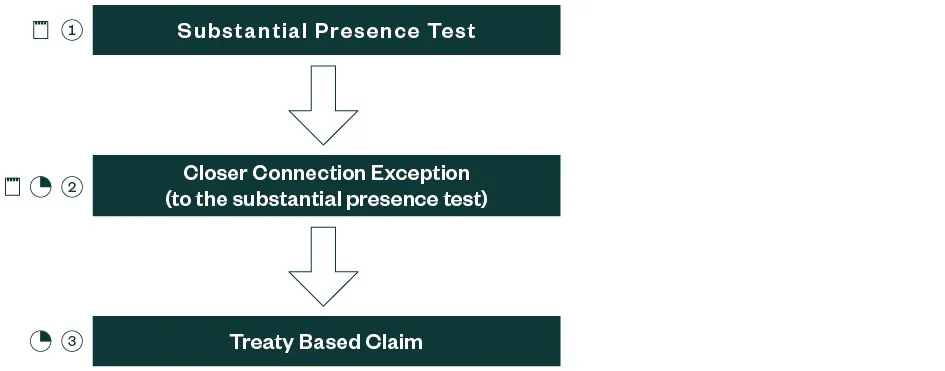
The following discussion will outline the basic rules for determining if you're an income tax resident and how to properly present your non-US income and investments to the U.S. government.
Why tax residency status is important
Residency status plays a significant role in determining an individual’s federal tax obligation and the amount of reporting required for non-U.S. investments. Understanding tax residency and how it can impact individual reporting needs, income calculations, and compliance requirements, can make navigating the U.S. tax landscape less complex.
Tax residency status is complex and can easily be confused with other aspects of residency. Keep in mind tax residency is:
- Unrelated to immigration or visa status.
- Not the same as U.S. estate tax residency or U.S. domicile.
- Not the same as resident of one of the 50 states. It’s possible to be a state income tax resident but not a federal income tax resident.