Article
FASB issues standard to enhance transparency of income tax disclosures
Jan. 28, 2024
The Financial Accounting Standards Board (FASB) issued Accounting Standards Update (ASU) 2023-09, Income Taxes (Topic 740): Improvements to Income Tax Disclosures.
The ASU expands the income tax rate reconciliation disclosure and income taxes paid information to address investor requests for more transparent income tax disclosures.
The amendments apply to all entities subject to income taxes, with certain disclosure requirements only applicable to public business entities (PBE).
Key provisions
During the FASB’s 2021 agenda consultation process, investors expressed concern that existing income tax disclosures don’t provide sufficient information to understand the tax provision for an entity that operates in multiple jurisdictions. According to feedback received by the FASB, investors want to better:
- Understand an entity’s exposure to potential changes in jurisdictional tax legislation and the ensuing risks and opportunities
- Assess income tax information that affects cash flow forecasts and capital allocation decisions
- Identify potential opportunities to increase future cash flows
Rate reconciliation disclosures
Under current generally accepted accounting principles (GAAP), PBEs are required to disclose a reconciliation between the reported income tax expense — or benefit — from continuing operations and the amount computed by multiplying the income — or loss — from continuing operations before tax by the applicable statutory federal income tax rate of the jurisdiction of domicile.
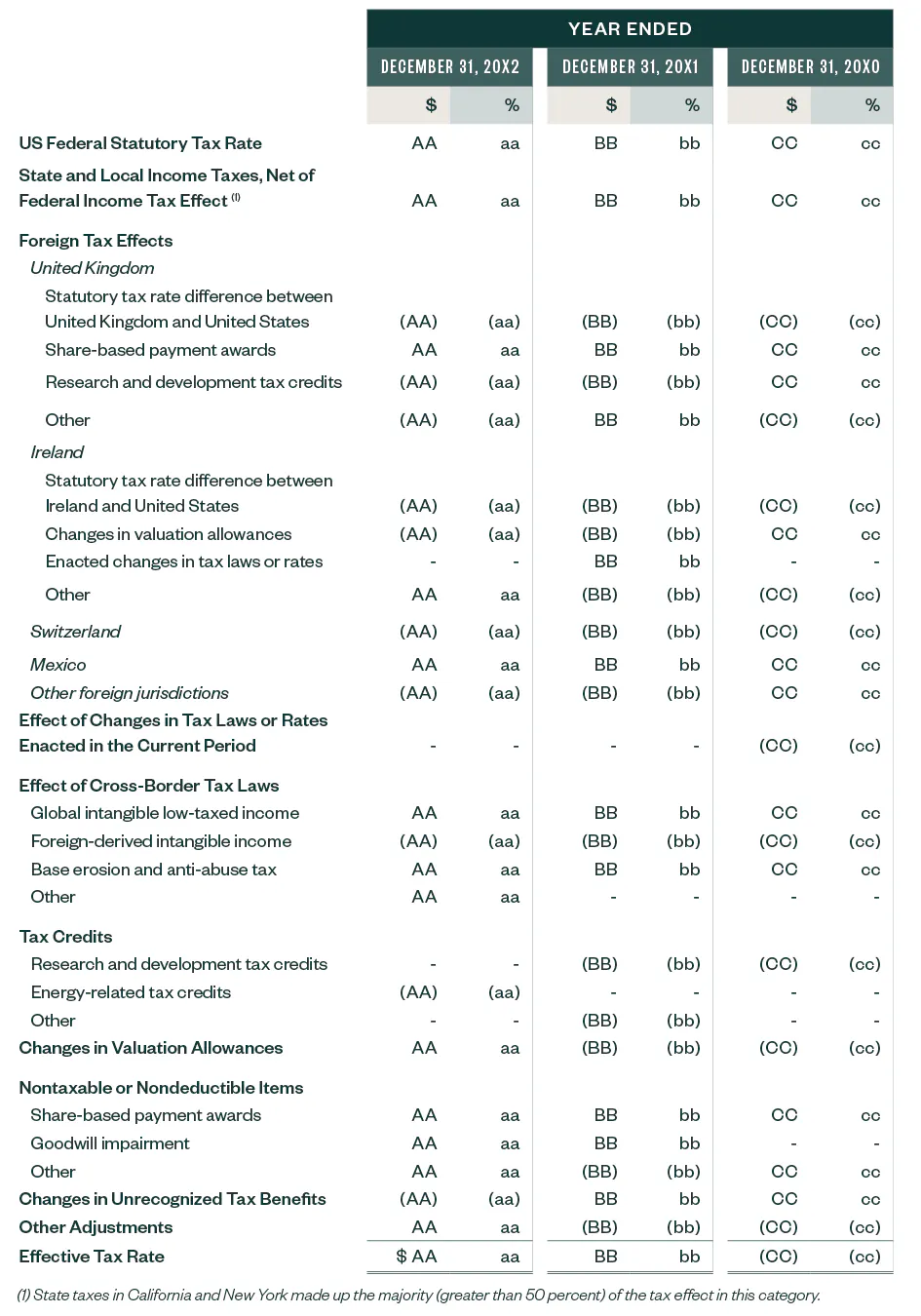
To address investors’ requests for greater transparency, the amendments prescribe the disaggregation of information to be presented in the rate reconciliation. PBEs are annually required to provide a tabular rate reconciliation containing specific categories, using both percentages and reporting currency amounts. Additional information is required for reconciling items that meet a quantitative threshold.
In the tabular rate reconciliation, PBEs are required to disclose the following eight categories:
The information provided here is of a general nature and is not intended to address the specific circumstances of any individual or entity. In specific circumstances, the services of a professional should be sought. Tax information, if any, contained in this communication was not intended or written to be used by any person for the purpose of avoiding penalties, nor should such information be construed as an opinion upon which any person may rely. The intended recipients of this communication and any attachments are not subject to any limitation on the disclosure of the tax treatment or tax structure of any transaction or matter that is the subject of this communication and any attachments.