Article
SEC amends the accelerated filer and large accelerated filer definitions
March 18, 2020
On March 12, 2020, the Securities and Exchange Commission (SEC) issued a final rule, Release No. 34-88365, Amendments to the Accelerated and Large Accelerated Filer Definitions. The amendments expand the number of issuers that qualify as non-accelerated filers, resulting in certain issuers no longer being required to provide auditor attestation of internal control over financial reporting (ICFR).
All issuers will continue to be required to establish and maintain effective ICFR, and their principal executive and financial officers will continue to be required to certify their responsibilities related to ICFR.
The amendments are effective 30 days after publication in the Federal Register and will apply to an annual report filing due on or after the effective date.
Key provisions
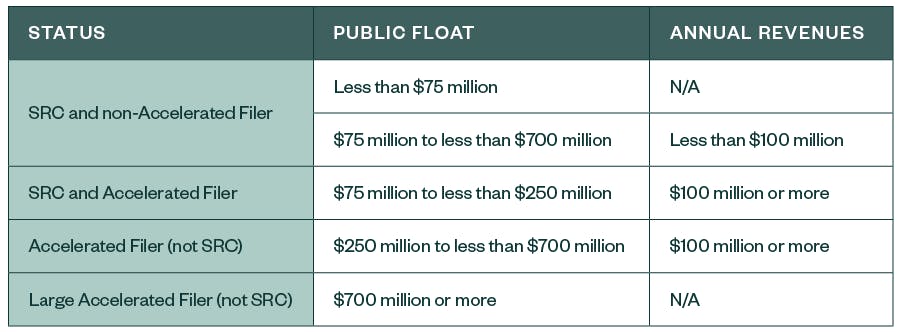
In June of 2018, the SEC amended the smaller reporting company (SRC) definition to include registrants with either:
- A public float of less than $250 million
- A public float of less than $700 million and annual revenues of less than $100 million
In conjunction with that change, the SEC eliminated the automatic exclusion of SRCs in the definitions of accelerated and large accelerated filers — resulting in some issuers being categorized as both SRCs and accelerated filers. The new amendments address this issue by better aligning the definitions of SRCs and accelerated filers.
Smaller reporting companies’ eligibility and exclusions
The final rule amends the accelerated filer definition under Rule 12b-2 of the Exchange Act of 1934 (Rule 12b-2) to exclude any issuer that’s eligible to be an SRC under the SRC revenue test. Accordingly, an issuer is categorized as a non-accelerated filer if the issuer has a public float of less than $700 million as of the last annual measurement date and annual revenues of less than $100 million in the most recently completed fiscal year.
Issuers meeting those thresholds aren’t subject to the accelerated filing deadlines or the internal control over financial reporting auditor attestation requirement. However, the amendments don’t change management’s responsibilities, and these issuers will still be required to establish and maintain the effectiveness of their internal control over financial reporting.