
Article
Washington state B&O tax guidelines for ERC credits and COVID-19 relief
Aug. 2, 2022 · Authored by Sarah Correia
The Employee Retention Tax Credit (ERTC, also referred to as the ERC credit) was made available to businesses as an employment tax credit throughout the pandemic. This change was enacted through the Coronavirus Aid, Relief, and Economic Security Act (CARES) on March 27, 2020, and extended through the Consolidated Appropriations Act, 2021 (CAA) and the American Rescue Plan Act (ARPA).
The Washington Department of Revenue (DOR) released guidance clarifying the Washington business and occupation (B&O) tax treatment of COVID-19 related relief.
Employee retention tax credit update
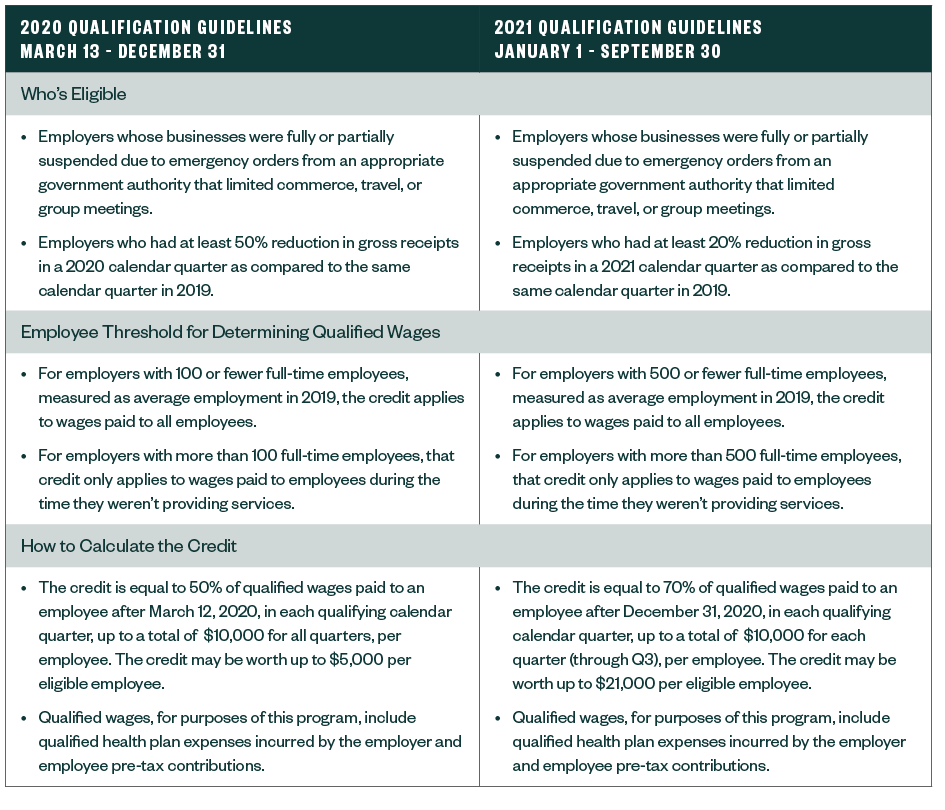
In November 2021, the Infrastructure Investment and Jobs Act (IIJA) was signed by President Joe Biden, retroactively terminating ERC credits for the fourth quarter of 2021. This limited the availability of credit to qualified periods between March 13, 2020, through Sept. 30, 2021.
Below are details about how employers could qualify as well as eligibility requirements.
ERC credit eligibility and guidelines
Washington state B&O tax treatment
Under GAAP, for-profit enterprises have several allowable accounting conventions to record the ERC credit. The most common convention for-profit enterprises use is to account for the credit related to previously paid payroll taxes as a loss recovery. When the loss recovery becomes probable under Accounting Standards Board (ASB) Topic 450, a for-profit enterprise would record the transaction as a debit to accounts receivable and a credit to either payroll tax expense or recorded as other income.
Where a business was eligible for the ERC credit and received it, this then brings into question whether ERC funds are gross income subject to Washington B&O tax.
Financial assistance programs established by the Federal government for COVID-19 relief have been contemplated by the Washington State Department of Revenue (DOR), where funds received were given an exemption under HB 1095 as qualifying grants defined as an amount received that concurrently meet all of the following criteria:

The information provided here is of a general nature and is not intended to address the specific circumstances of any individual or entity. In specific circumstances, the services of a professional should be sought. Tax information, if any, contained in this communication was not intended or written to be used by any person for the purpose of avoiding penalties, nor should such information be construed as an opinion upon which any person may rely. The intended recipients of this communication and any attachments are not subject to any limitation on the disclosure of the tax treatment or tax structure of any transaction or matter that is the subject of this communication and any attachments.