
Article
Locations announced for Medicare mandatory payment model for specialty providers
Aug. 19, 2025 · Updated March 26, 2026 · Authored by Georgia Green and Rachael Peterson
The Centers for Medicare & Medicaid Services (CMS) published the Final 2026 Physician Fee Schedule (PPFS) Rule on Oct. 31, 2025. The rule finalized a new mandatory value-based care program, the Ambulatory Specialty Model (ASM), designed to reshape how specialty care is delivered to Medicare fee-for-service (FFS) patients with congestive heart failure and low back pain — two conditions associated with high Medicare spending and considerable opportunities for cost reduction.
The five-year model is slated to begin on Jan. 1, 2027, and run until Dec. 31, 2031.
ASM’s goal is to reward specialty clinicians who aid in their patients’ overall healthcare quality and efficiency. CMS hopes to encourage specialists to collaborate with primary care providers to improve chronic disease management, detect risk signs early, and prevent the worsening or recurrence of chronic conditions.
Model location and participants
ASM will include roughly one-quarter of core-based statistical areas (CBSAs) and metropolitan divisions throughout the country. CMS has published the list of selected geographic areas, as well as the preliminary dataset of selected providers. CMS intends to publish a final dataset of 2027 participants in summer 2026.
The following physician specialists located in the selected CBSAs would be mandated to participate, if they have historically treated at least 20 Medicare FFS episodes per year:
- Congestive heart failure: General cardiology,
- Low back pain: Anesthesiology, pain management, interventional pain management, neurosurgery, orthopedic surgery, and physical medicine and rehabilitation.
Physician eligibility is assessed individually, not at the practice level.
Model requirements
CMS will provide enhanced data feedback to participants and require them to implement the following activities:
- Collaborative Care Arrangements with primary care
- Preventive care screening in partnership with primary care
- Support for lifestyle changes and health-related social needs screening in partnership with primary care
- Health information exchange data sharing
Payment methodology
Participant performance will be assessed across four categories, mirroring the Merit-Based Incentive Payment System (MIPS) Value Pathways (MVP) program:
- Quality
- Cost
- Improvement Activities
- Improving Interoperability
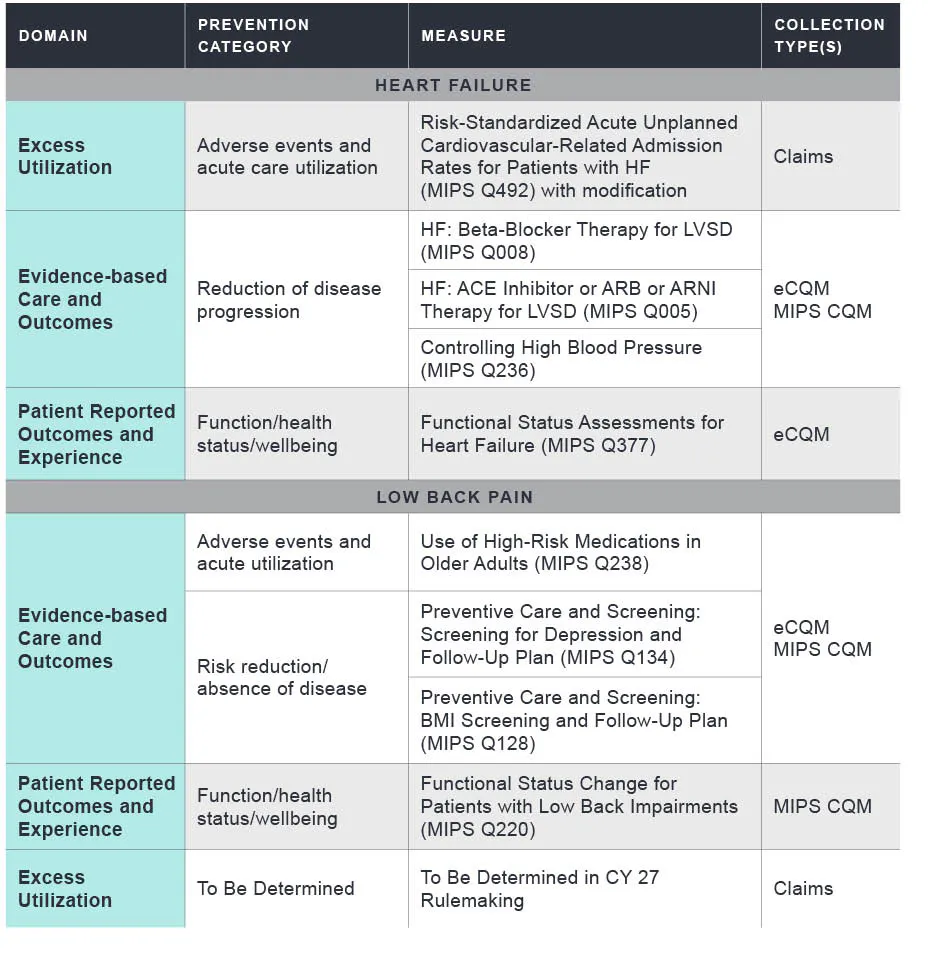
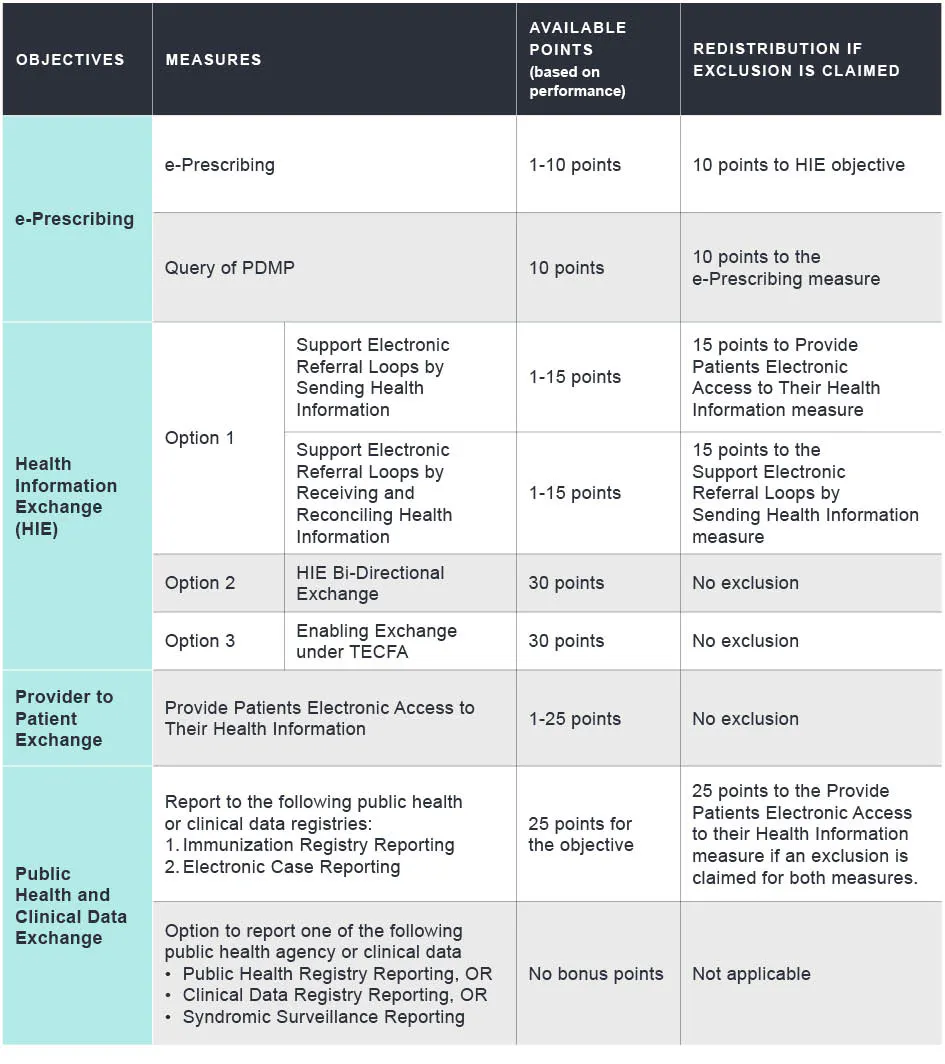
The tables below outline the Quality and Promoting Interoperability category requirements. Model participants should work with their electronic health record (EHR) vendor to ensure that reporting requirements will be fulfilled, particularly given the challenge of electronic clinical quality measure (eCQM) reporting, which is end-to-end electronic reporting for all patients, all payors.
ASM Measure Sets for the ASM Quality Performance Category
Promoting Interoperability Measures
There are two Improvement Activities measures, which will be reported as yes or no attestations:
- Improvement Activity 1 (IA-1): Connecting to Primary Care and Ensuring Completion of Health-Related Social Needs Screening
- Improvement Activity 2 (IA-2): Establishing Communication and Collaboration Expectations with Primary Care using Collaborative Care Arrangements (CCA)
To receive the maximum score available for the Improvement Activities performance category, ASM participants must enter into at least one CCA with a clinician who provides primary care services to at least one shared ASM beneficiary.
Total performance on measures within these four domains will determine if the participant receives a positive, neutral, or negative payment adjustment on Medicare Part B claims, two years after the performance year — that is, payment years spanning 2029-2033. ASM participants are exempt from MIPS reporting for the duration of ASM.
High performers’ total awards will be equally balanced or less than the low performers’ total payment reductions. The first program year will result in payment adjustments ranging from -9% to +9%.
Implications for providers
For specialty providers, ASM represents both an opportunity and a challenge. On one hand, the model offers rewards for high-quality, integrated care. Specialists who are employed by or affiliated with a health system or Accountable Care Organization (ACO) that’s already delivering advanced primary care and care management services will likely have a head start in ASM. The collaboration between specialty and primary care providers will benefit both simultaneously if they are participating in value-based payment arrangements.
Additionally, participants will likely benefit from increased data transparency from CMS, if they are able to turn the data into actionable insights that reduce hospitalizations and unnecessary treatments.
On the other hand, ASM participants may find that, similar to the broader MIPS program, the vast majority of participants achieve high performance scores, resulting in negligible positive payment adjustments from CMS, as the program maintains budget neutrality. For example, in 2023, 81% of MIPS reporters earned a positive payment adjustment of up to +2.15%, while 5% earned a neutral adjustment (0%), and 14% received a negative adjustment of up to –9%. Nonetheless, it’s certainly favorable to receive a positive payment adjustment, even if small!
The majority of providers receiving negative payment adjustments in the MIPS program are rural or small practices and solo practitioners, and ASM is likely to perpetuate that trend.
As CMS continues to expand value-based payment models, ASM is a good step toward further transforming specialty care delivery. Providers who proactively engage with ASM can position themselves for success in a healthcare environment increasingly focused on quality, efficiency, and patient-centered care, while those who ignore the call will be facing increased pay cuts in future years.
Next steps
CMS has published a participant readiness road map that includes a pre-implementation checklist of activities. Participants are encouraged to review the preliminary participant dataset to confirm participation and submit the ASM participant contact information form.
As noted above, participants should work with their EHR vendor to ensure that data reporting requirements will be fulfilled. Participants are advised to work with an attorney or knowledgeable consultant so that legal waivers are appropriately utilized in the development of the Collaborative Care Arrangements with primary care providers.