
Article | Executive briefing
IEEPA refunds: Latest CBP guidance for importers
Refund processing gains momentum ahead of CAPE Phase 3
March 13, 2026 · Updated July 24, 2026 · Authored by Pete Mento, Tosca Derrick and Danae Helgeson
U.S. Customs and Border Protection (CBP) continues to expand the International Emergency Economic Powers Act (IEEPA) refund process as guidance on IEEPA refunds and Consolidated Administration and Processing of Entries (CAPE) functionality continue to evolve. This page provides the latest updates, background, and practical guidance to help importers of record understand evolving CBP requirements, evaluate refund opportunities, and prepare for the IEEPA refund process.
On this page:
- Latest IEEPA refund update
- Background: IEEPA refunds
- What importers should do now
- Timeline of key IEEPA refund developments
- How to start your IEEPA refund claim
- IEEPA refund update archive
Latest IEEPA refund update
A closed status conference was held on July 14 in Euro-Notions Florida, Inc. v. United States (Court No. 25-00595), where the parties discussed ongoing developments related to the Consolidated Administration and Processing of Entries (CAPE) program. The day before, Brandon Lord, executive director of U.S. Customs and Border Protection's (CBP) Trade Programs Directorate, reported that CBP has accepted approximately $121.75 billion in IEEPA refund claims for processing, with approximately $83.3 billion already disbursed through the CAPE Refund component. A primary factor delaying Treasury disbursements remains the absence of Automated Clearing House (ACH) account information for the Importer of Record (IOR) or its authorized designee [1].
The Court directed CBP to submit its next CAPE progress report by Aug. 4, 2026. If the Euro-Notions case is voluntarily dismissed before then, the report will instead be filed in the Freestyle World case. A closed settlement conference is scheduled for Aug. 5, 2026 [1].
In anticipation of the late July rollout of CAPE Phase 3, the Court also directed CBP to reliquidate certain finally liquidated entries associated with approximately 3,700 Court of International Trade (CIT) cases while additional functionality for entries with open protests continues to be developed. CAPE remains the exclusive mechanism for processing IEEPA refunds. Before CAPE declarations can be submitted, CBP will issue submission instructions to plaintiffs' counsel, who will then provide the required Importer of Record information [2].
As refund volumes continue to increase, importers should confirm ACH enrollment, verify CBP Form 4811 designations, identify potential validation issues before submission, and develop a filing strategy that minimizes processing delays. Baker Tilly can help assess CAPE eligibility and prepare refund submissions.
Background on IEEPA refunds
On Feb. 20, 2026, the U.S. Supreme Court ruled that the use of IEEPA tariffs to impose certain tariffs was unlawful. The affected tariffs had been imposed beginning Feb. 4, 2025, under multiple presidential executive orders. Following the decision, the CIT directed CBP to establish procedures for processing IEEPA refunds owed to eligible importers.
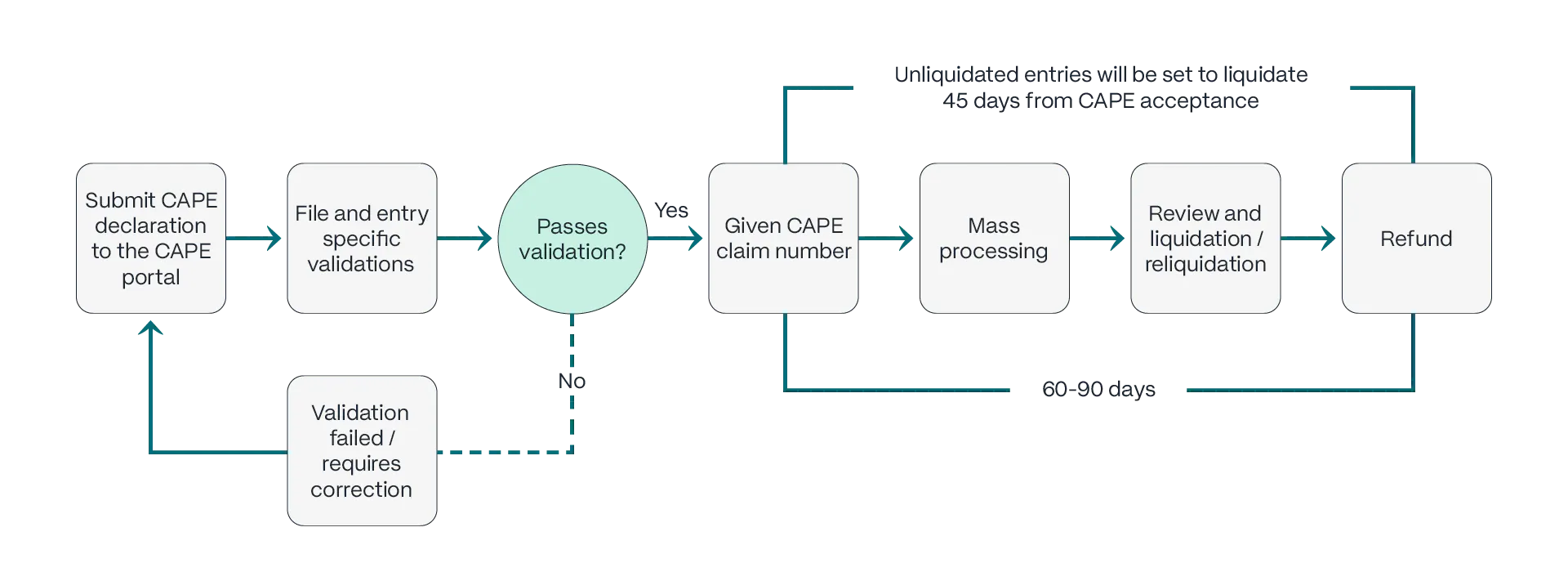
CBP launched Phase 1 of the CAPE tool within the Automated Commercial Environment (ACE) Secure Data Portal on April 20, 2026, allowing eligible importers and authorized customs brokers to begin submitting CAPE declarations for qualifying IEEPA duty refunds. Rather than processing refunds on an entry-by-entry basis, CAPE is designed to consolidate refund processing, including applicable interest. Phase 1 currently applies to certain unliquidated entries and certain entries within 80 days of liquidation, while Phase 2 expands eligibility to include qualifying reconciliation entries. The processing timeline is illustrated below.
What importers should do now
As CAPE functionality continues to expand, importers should review their entry population to identify eligible refund opportunities before key filing deadlines expire. Coordinating refund claims with reconciliation activity is increasingly important, as filing reconciliation before submitting a CAPE declaration could eliminate eligibility for certain underlying entries. Importers should also identify upcoming liquidation and protest deadlines and develop a filing strategy that preserves available refund rights while minimizing operational disruption.
Importers planning to pursue IEEPA refunds should also ensure they have access to the ACE Secure Data Portal. Establishing an ACE account can take up to six weeks, and additional time may be required to configure electronic refund capabilities. This preparation is especially important because CBP's Interim Final Rule (IFR) on Electronic Refunds (91 FR 21) requires all refunds to be issued electronically through ACE. Without an active ACE account and electronic refund setup, importers may experience delays in receiving approved refunds. CBP provides instructions for establishing an ACE Secure Data Portal account on its website [5].
Baker Tilly continues to monitor CBP guidance, CAPE implementation, and court proceedings as the IEEPA refund process evolves. As additional refund functionality becomes available, importers should continue evaluating their filing strategies to preserve eligibility and maximize potential refund opportunities.
Timeline of key IEEPA refund developments
Month | Date | Event or milestone | Key outcomes and notes |
February 2025 | February 4, 2025 | IEEPA duties became applicable to covered imports entered for consumption on or after this date. | For customs purposes, applicability is based on the entry date or warehouse withdrawal date, not ship or arrival date. Applicable rates varied by country of origin and Executive Order in effect at entry. |
February 2026 | February 20, 2026 | U.S. Supreme Court held that use of IEEPA to impose certain tariffs was unlawful. | Following the decision, the CIT directed CBP to establish refund procedures. Importers became legally entitled to pursue refunds once CBP procedures were published. |
March 2026 | March 2, 2026 | Federal Circuit denied DOJ request for delay and returned case to the CIT. | CIT regained authority to define IEEPA refund mechanics. |
March 4, 2026 | Judge Richard Eaton ordered CBP to process unliquidated entries without IEEPA tariffs and reliquidate non-final liquidated entries. | CBP also ordered to explain refund and reliquidation procedures. | |
March 6, 2026 | CBP Executive Director Brandon Lord filed response outlining operational challenges with immediate refunds. | CBP estimated manual processing would require 4.4+ million labor hours for 53+ million entries. Proposed automated ACE-based refund process with tentative launch target of April 20, 2026. CIT paused immediate refund requirement. | |
March 12, 2026 | CBP formally introduced the CAPE (Consolidated Administration and Processing of Entries) system within ACE. | CAPE designed to automate refund requests, recalculations, liquidation/reliquidation, and refunds. Four components introduced: Claim portal, Mass processing, Review & liquidation/reliquidation, and Refund processing. Components estimated 40% - 80% complete. | |
March 19, 2026 | CBP provided CAPE development progress update. | Overall completion increased from 63% to 65%. Claim portal: 73%, Mass processing: 45%, Refund processing: 63%, Review & liquidation/re-Liquidation: 80%. | |
March 20, 2026 | CIT confirmed all IEEPA tariffs, including Brazil and India tariffs, are eligible for refunds. | CBP ordered to provide additional CAPE progress report by March 31, 2026. | |
March 27, 2026 | CIT expanded on their March 4th order to include finally liquidated entries. | CBP ordered to broaden IEEPA refund scope to those entries that have completed both the 314-day liquidation cycle and the 180-day protest period. | |
March 31, 2026 | CBP reported CAPE Phase 1 approximately 75% complete and outlined Phase 1 scope and exclusions. | Scope included unliquidated entries and entries within voluntary reliquidation window. Expanded functionality added warehouse and suspended entries. Exclusions included finally liquidated entries, drawback, protest, AD/CVD, and non-ACE entries. | |
April 2026 | April 10, 2026 | CBP issued CSMS #68315804 confirming April 20 launch of CAPE Phase 1. | Confirmed ACE portal and ACH enrollment requirements. Refunds to be consolidated rather than entry-by-entry. |
April 13, 2026 | CBP issued CSMS #68340863 with operational guidance for CAPE deployment. | Guidance detailed CSV bulk filing process, automated validation, refund processing timelines, ACH refunds, and operational restrictions for protests, drawbacks, PSC filings, and AD/CVD entries. | |
April 14, 2026 | CBP reported CAPE Phase 1 reached approximately 90% completion. | Claim portal: 95%, Mass processing: 85%, Review & liquidation/reliquidation: 90%, Refund processing: 90%. Final testing underway. Approximately 82% of IEEPA refunds (~$127B) expected to process via ACH automation. | |
April 20, 2026 | CBP issued CSMS #68396594 announcing CAPE Phase 1 is live in ACE. | Importers and authorized customs brokers may now file CAPE declarations through ACE portal accounts. CAPE consolidates IEEPA duty refunds, including interest, rather than processing refunds entry-by-entry. Phase 1 is limited to certain unliquidated entries and certain entries within 80 days of liquidation. Supporting resources released by CBP include the CAPE information notice [6], ACE portal: CAPE declarations quick reference guide [7], and the IEEPA duty refunds page [8]. | |
April 28, 2026 | CBP provided update to the CIT on CAPE processing status. | Approximately 11 million entries were accepted by CAPE and passed entry-specific validations. Of those, about 1.74 million entries have been liquidated and entered the refund process. While the system is generally functioning as intended, stakeholders reported operational challenges including ACE access issues, user confusion, questions regarding interest calculations, and ongoing concerns with ineligible or complex entry types. | |
May 2026 | May 11, 2026 | CBP provided update to CIT on CAPE processing status. | CBP received 126,237 CAPE declarations, of which 86,874 successfully passed file validation requirements. Those validated declarations included approximately 15.1 million entries accepted for IEEPA duty removal processing through CAPE, with approximately 8.34 million entries already liquidated and/or reliquidated without IEEPA duties, representing an estimated $35.46 billion in duty refunds and interest. CBP also reported that 1,880 consolidated refunds remain pending transmission to the U.S. Treasury due to missing ACH information from the IOR or an authorized CBP Form 4811 designee. |
May 26, 2026 | CBP provided update to CIT on CAPE processing status. | CBP reported that more than 157,000 CAPE declarations had been submitted as of May 26, with approximately $85 billion in IEEPA refunds accepted for processing and $20.6 billion already processed through the CAPE Refund component. | |
May 27, 2026 | CIT questions ongoing suspension of universal refund order. | During a May 27 conference, the CIT reviewed ongoing importer challenges with CAPE, including issues involving HTSUS 9817 claims, and questioned CBP's continued suspension of the Court's order directing refunds for all affected importers. The Court also ordered CBP to provide its next CAPE progress update by June 10. | |
June 2026 | June 10, 2026 | CBP reports nearly $95 billion in accepted IEEPA refunds and announces CAPE Phase 2 & 3 timeline. | CBP reported that more than 180,000 CAPE declarations had been submitted as of June 10, with approximately $94.94 billion in IEEPA refunds accepted for processing and $23.68 billion already refunded through the CAPE Refund component. CBP also announced that CAPE Phase 2 is expected to launch on June 29 to support reconciliation entries, with Phase 3 anticipated in late July to expand processing to additional entry types, including those associated with CIT litigation. Meanwhile, the government continues to challenge the CIT's authority to order nationwide IEEPA refunds while maintaining that additional time is needed to implement functionality for more complex entry categories. |
June 23, 2026 | CBP announced CAPE Phase 2 enhancements with deployment scheduled for June 29, 2026 | CAPE Phase 2 allows eligible underlying entry summaries (Types 01, 02, and 06) flagged for reconciliation to be submitted for IEEPA refunds, provided the entries remain unliquidated or are within 80 days of liquidation. Once a Reconciliation Entry (Type 09) is filed, the associated underlying entries become ineligible for CAPE Phase 2 processing, making filing sequence a critical consideration. CBP updated its IEEPA Refunds FAQ, confirmed continued development of additional CAPE functionality, and was directed by the CIT to submit its next CAPE progress report by July 1, 2026. | |
June 29, 2026 | CAPE Phase 2 became fully operational | CAPE Phase 2 expanded refund processing to reconciliation-flagged entries, including approximately 1.6 million eligible entries. | |
July 2026 | July 1, 2026 | CBP releases July CAPE progress update | CBP reported that, as of July 1, more than 213,000 CAPE declarations had been submitted, with approximately 70% passing initial file validation and 18.1 million entries successfully passing entry-level validation. The agency has accepted approximately $104.29 billion in IEEPA duty refunds for processing, with $71.06 billion already disbursed through the CAPE Refund component |
July 7, 2026 | CBP revises CAPE eligibility for warehouse entries | CBP removed warehouse entries (Types 21 and 22) from CAPE eligibility, limiting refunds to eligible warehouse withdrawal entries (Types 31, 32, 34, and 38) where IEEPA duties were assessed. Warehouse entries previously accepted through CAPE without a corresponding withdrawal will not be reliquidated for refunds. Importers must submit new CAPE declarations for the applicable warehouse withdrawal entries. |
Start your IEEPA refund claim
As CAPE functionality continues to expand, importers should begin evaluating eligible entries and developing a refund strategy before key filing deadlines pass. Baker Tilly's Global Trade Management team can help assess CAPE eligibility, prioritize claims, coordinate reconciliation strategies, and navigate the evolving refund process.
Ready to get started? Contact our Global Trade Management team to start your IEEPA refund claim.
IEEPA refund update archive
Looking for previous updates? Browse earlier IEEPA refund developments below.
Following the Supreme Court's February ruling, CBP outlined its proposed approach for automating IEEPA refunds through a new capability within the ACE known as the CAPE. The update explained that CAPE would automate refund requests, duty recalculations, liquidation or reliquidation and electronic refund processing through four integrated components.
The briefing also summarized the Court of International Trade's early rulings, CBP's operational challenges, and the importance of obtaining ACE Portal access while importers prepared documentation needed to support future refund claims.
CBP reported that development of CAPE Phase 1 had reached approximately 75% completion, with continued progress across all four system components. The Claim Portal increased from 73% to 85%, Mass Processing from 45% to 60%, Review and Liquidation remained at 80%, and Refund Processing advanced from 63% to 75%.
CBP also outlined the initial scope of Phase 1, including unliquidated entries, recently liquidated entries within the voluntary reliquidation window and expanded functionality for warehouse and suspended entries. Reconciliation, drawback, protest, AD/CVD and non-ACE entries remained outside the initial rollout and were slated for future CAPE phases.
On April 20, 2026, CBP officially launched the CAPE tool within the ACE Secure Data Portal, allowing importers and authorized customs brokers to begin filing IEEPA refund declarations. Early participation was strong, with more than 55,000 users logging in on the first day to submit claims covering approximately 4 million imports.
While many declarations were successfully submitted, some users experienced system latency, intermittent login issues, and filing errors as the portal handled significant submission volumes. CBP also released an Entry Summary Error Dictionary to help filers interpret and resolve common CAPE submission errors. Despite these early challenges, the launch marked a significant milestone in implementing the Court of International Trade's refund directive.
On May 26, 2026, CBP reported that approximately 157,402 CAPE declarations had been submitted, with roughly 70% passing initial file validation. Of those submissions, 15.85 million entries successfully passed validation while 3.48 million entries failed due to unmet eligibility requirements. In total, approximately $85 billion in IEEPA refunds had been accepted for processing, with approximately $20.6 billion already processed through the CAPE Refund component.
During a May 27 conference, the Court of International Trade reviewed ongoing importer challenges with CAPE, including issues involving HTSUS 9817 claims, while questioning CBP's continued suspension of refunds for certain finally liquidated entries. Importers were encouraged to validate CAPE submissions carefully and monitor entries approaching the Phase 1 eligibility deadline.
On June 10, 2026, CBP reported that more than 180,000 CAPE declarations had been submitted since CAPE launched, with approximately 70% passing initial file validation. Of the validated declarations, 16.74 million entries successfully passed entry-level validation, while 3.99 million entries failed due to unmet eligibility requirements. CBP also reported that approximately $94.94 billion in IEEPA refunds had been accepted for processing, with approximately $23.68 billion already refunded through the CAPE Refund component.
During a June 9 hearing, CBP announced that CAPE Phase 2 was expected to launch June 29 to support reconciliation entries, with Phase 3 anticipated later in July to expand processing for additional entry types, including those associated with ongoing CIT litigation.
The Department of Justice also continued challenging the Court of International Trade's authority to require nationwide refunds while CBP maintained that additional time was needed to implement functionality for more complex entries. Importers were encouraged to monitor protest deadlines and evaluate available options as litigation continued.
On June 23, 2026, CBP published additional guidance on CAPE Phase 2 functionality ahead of its June 29 launch. The enhancement allows CAPE declarations for underlying entry summaries (entry types 01, 02, and 06) associated with reconciliation entries (entry type 09), expanding refund opportunities for eligible importers.
Reconciliation allows importers to update information that could not be determined at the time of entry, including customs value, HTSUS 9802 claims, tariff classification, and free trade agreement eligibility. As with CAPE Phase 1, declarations are limited to eligible entries that remain unliquidated or are within 80 days of liquidation.
Importers should carefully evaluate the timing of reconciliation filings. Once a reconciliation entry has been filed through the normal process, the associated underlying entries are no longer eligible for CAPE Phase 2 processing. Coordinating liquidation dates, protest deadlines, and reconciliation timelines before filing can help preserve refund eligibility and maximize available recovery opportunities.
CBP also updated its International Emergency Economic Powers Act (IEEPA) Duty Refunds webpage with additional guidance for the trade community while continuing development of CAPE functionality for more complex refund scenarios. The U.S. Court of International Trade also continued overseeing implementation of the refund process and directed the government to submit another CAPE progress report by July 1.
On July 1, 2026, CBP provided the U.S. Court of International Trade (CIT) with its latest progress update on the implementation of CAPE. Since CAPE launched on April 20, more than 213,000 CAPE declarations have been submitted, with approximately 70% passing initial file validation. Of the validated submissions, 18.1 million entries successfully passed entry-level validation, while 4.36 million entries were determined to be ineligible because they did not meet CAPE eligibility requirements. To date, CBP has accepted approximately $104.29 billion in refunds of duties imposed under the IEEPA, with approximately $71.06 billion already processed through the CAPE Refund component.
CBP also successfully launched CAPE Phase 2 on June 29, expanding refund processing to eligible reconciliation-flagged entries for which a Reconciliation Entry (Type 09) has not yet been filed. The agency subsequently confirmed that approximately 1.6 million reconciliation-flagged entries were successfully filed through CAPE and queued for processing.
In additional guidance issued through the Cargo Systems Messaging Service (CSMS) [3], CBP announced that, effective July 7, warehouse entries (Types 21 and 22) are no longer eligible for CAPE declarations. Warehouse withdrawal entries (Types 31, 32, 34, and 38) remain eligible because IEEPA duties are assessed upon withdrawal. Warehouse entries accepted through CAPE between April 20 and July 6 without corresponding warehouse withdrawals will not be reliquidated with IEEPA refunds. Importers and filers must instead submit new CAPE declarations for the applicable warehouse withdrawal entries on which IEEPA duties were paid.
CBP also issued a fact sheet warning importers and customs brokers about fraudulent solicitations from entities claiming they can expedite or guarantee CAPE refunds [4]. The agency encourages the trade community to follow data security best practices, remain alert to potential fraud indicators, and report suspicious activity to CBP. Importers should continue working with trusted customs compliance advisors when preparing CAPE refund declarations and safeguarding sensitive commercial and import data.
References and resources
- [1] "Euro-Notions Florida, Inc. v. United States, Court No. 25-00595, Order, ECF No. 46 (Ct. Int'l Trade July 15, 2026)."
- [2] "In re Tariffs Collected in Reliance on International Emergency Economic Powers Act, Order, Court No. 1:25-cv-00078-RKE (July 15, 2026)."
- [3] https://content.govdelivery.com/accounts/USDHSCBP/bulletins/41ece9d?7
- [4] https://www.cbp.gov/sites/default/files/2026-07/26_0706_ieepa_cape_fraud_fact_sheet.pdf
- [5] https://www.cbp.gov/trade/automated/how-to-use-ace/portal-applying
- [6] https://www.cbp.gov/document/guidance/trade-information-notice-cape
- [7] https://www.cbp.gov/sites/default/files/2026-04/ace_portal_cape_qrg_trade_0.pdf
- [8] https://www.cbp.gov/trade/programs-administration/trade-remedies/ieepa-duty-refunds


Article Tags

Understanding U.S. trade remedies: What importers need to know
The information provided here is of a general nature and is not intended to address the specific circumstances of any individual or entity. In specific circumstances, the services of a professional should be sought. Tax information, if any, contained in this communication was not intended or written to be used by any person for the purpose of avoiding penalties, nor should such information be construed as an opinion upon which any person may rely. The intended recipients of this communication and any attachments are not subject to any limitation on the disclosure of the tax treatment or tax structure of any transaction or matter that is the subject of this communication and any attachments.