
Article
Missouri fuel tax refund: A strategic opportunity for businesses and individuals
July 15, 2025 · Authored by Bob Johnson
Missouri offers a fuel tax refund program that allows eligible individuals and businesses to recover a portion of state fuel tax paid on gasoline used for non-highway purposes — or, more recently, for any purpose considering increases enacted through the 2021 gas tax legislation.
With significant fuel tax increases taking effect annually through 2026, the Missouri refund process presents a growing opportunity for taxpayers to recover a portion of fuel costs through proper documentation and timely filing.
Background: 2021 gas tax legislation (SB 262)
In 2021, Missouri enacted Senate Bill (SB) 262, which incrementally increased the state fuel tax from 17¢ per gallon to 29.5¢ per gallon by July 1, 2025. The legislation includes a refund mechanism for fuel purchased and used by Missouri residents for on-road purposes, such as personal vehicles.
This provision was designed to soften the financial impact of the tax increase by allowing taxpayers to reclaim the increased portion of the tax — provided they maintain proper documentation and submit refund claims on time.
Tax increase schedule
The fuel tax increased in five annual steps:
- Oct. 1, 2021–June 30, 2022: +2.5¢ (total 19.5¢ per gallon)
- July 1, 2022–June 30, 2023: +2.0¢ (total 21.5¢ per gallon)
- July 1, 2023–June 30, 2024: +2.0¢ (total 23.5¢ per gallon)
- July 1, 2024–June 30, 2025: +2.0¢ (total 25.5¢ per gallon)
- July 1, 2025–June 30, 2026: +2.0¢ (final rate 27.5¢ per gallon)
Note: There is also an additional 2¢ surcharge to support transportation funding, resulting in a total of 29.5¢ per gallon by fiscal year (FY) 2026.
Who can claim the refund?
Refund eligibility depends on how the fuel is used.
General consumers and residents
Missouri residents who purchase fuel for on-road personal vehicle use may request a refund of the increased portion only, meaning the incremental tax above 17¢. The refund is available only if:
- The fuel was purchased in Missouri
- The vehicle is registered in Missouri
- Detailed receipts and vehicle mileage logs are maintained
Businesses and off-road fuel users
Certain businesses or individuals who purchase fuel for off-road uses, such as agriculture, construction, landscaping, or fuel used in equipment not licensed for highway use, may qualify for a full refund of Missouri fuel tax, not just the incremental portion.
Governmental or tax-exempt entities
Public entities or not-for-profits that qualify for exemptions under Missouri law may also claim refunds in connection with approved uses.
Refund process and key requirements
To request a refund, taxpayers must complete and submit Form 4923-H – Missouri Motor Fuel Tax Refund Claim, along with:
- Original receipts or invoices showing fuel purchased in Missouri
- Proof of payment, such as canceled checks or credit card statements
- Vehicle or equipment use documentation, including odometer readings or usage logs, depending on the refund category
- Record of total miles driven in the year and miles driven in Missouri, if seeking the on-road use refund
- Claim period details, including gallons purchased and usage breakdown
Deadline to claim refund
Refund claims must be submitted by Sept. 30, 2025, following the end of the state’s fiscal year, which is June 30. For example, fuel purchased between July 1, 2023, and June 30, 2024, must be claimed by Sept. 30, 2024.
Late submissions will be denied unless reasonable cause is documented and approved by the Department of Revenue (DOR).
Rate tables for refund claims
The Missouri DOR publishes a chart annually to show the refund rate applicable per gallon for each fiscal year.
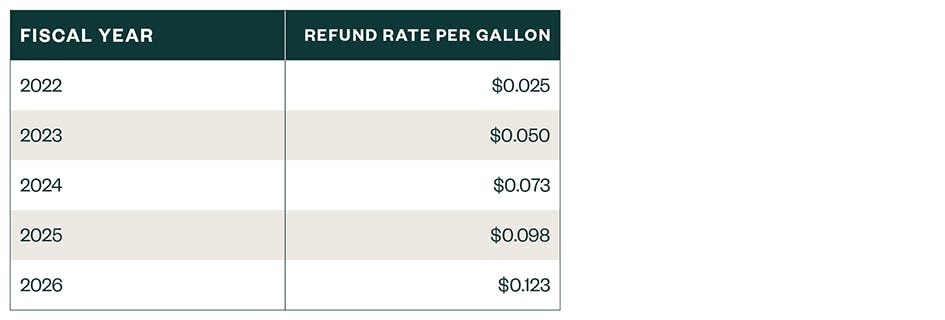
These rates reflect the incremental tax increase above the original 17¢ and are applicable to general consumer claims.
Tips for improving your refund
To get the most out of your refund, consider the following actions.
- Maintain detailed records. Keep all receipts, odometer logs, and proof of payment for every fuel purchase.
- Consolidate claims. Businesses with multiple vehicles or equipment units should aggregate purchases and usage data to streamline their claims.
- Segregate off-road fuel use. For companies using fuel in both taxable and nontaxable ways, it's critical to document and isolate gallons used off-highway.
- Verify purchase location. Only Missouri-purchased fuel is eligible for refund. Fuel bought out of state doesn’t qualify.
- Use electronic tracking tools. Companies with fleet management systems or fuel card programs can automate much of the documentation process.
Common errors to avoid
Below are common mistakes that could jeopardize your refund.
- Missing documentation. Claims lacking receipts or logs will be denied.
- Incorrect or incomplete forms. Be sure to use the most current version of Form 4923-H.
- Filing late. There is no grace period past Sept. 30. Submit early to avoid processing delays.
- Failing to track mileage. For on-road consumer claims, mileage logs are required to prove Missouri usage.
Recent developments and legislative outlook
Missouri’s fuel tax refund program has gained increased attention as fuel costs and tax rates rise. While the refund offers a meaningful benefit, critics argue the process is overly burdensome for the average consumer. There have been proposals in the Missouri legislature to simplify or eliminate the refund process in favor of broader exemptions or offsetting tax reductions, but none have passed as of mid-2025.
Businesses, however, remain well-positioned to leverage the refund as part of broader tax planning efforts — particularly in industries with significant off-road fuel use, such as:
- Construction and heavy equipment
- Agriculture and farming
- Landscaping services
- Manufacturing
- Utility operations


IRS issues guidance on prevailing wage and apprenticeship requirements
The information provided here is of a general nature and is not intended to address the specific circumstances of any individual or entity. In specific circumstances, the services of a professional should be sought. Tax information, if any, contained in this communication was not intended or written to be used by any person for the purpose of avoiding penalties, nor should such information be construed as an opinion upon which any person may rely. The intended recipients of this communication and any attachments are not subject to any limitation on the disclosure of the tax treatment or tax structure of any transaction or matter that is the subject of this communication and any attachments.