
Article
Financial forecasting: Six tips for private companies
Dec. 8, 2019 · Authored by Clayton Cafferata
Forecasting your private company’s finances is one of the most important parts of preparing for the next fiscal year and setting your business up for success. When combined with a top-notch accounting department, a financial forecast can be one of the most effective cash-management tools available.
However, finding the time to create your financial forecast can be challenging, and there are many different approaches depending on your company’s life-cycle stage, industry, or even end user.
As you prepare for the coming forecast period, these six tips and strategies might be useful.
1. Forecast scenarios
Predicting your company’s future can be particularly challenging, especially if your company is a startup or is growing significantly. Creating multiple forecast scenarios can help you understand how your company could be impacted by different potential outcomes.
The following four forecast scenarios, which we’ll discuss in detail below, could be helpful for your private company.
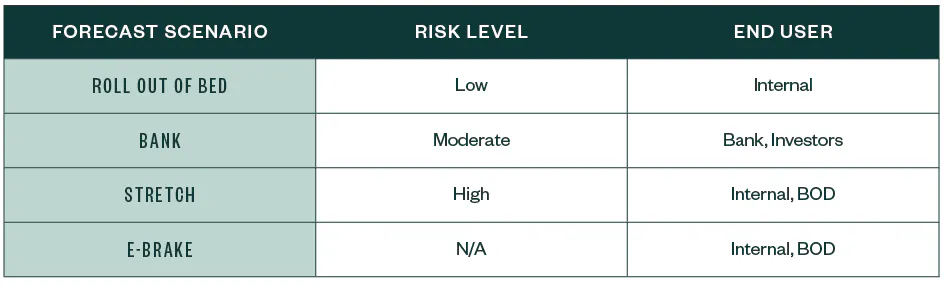
Each forecast scenario varies in terms of risk — such as the ability to hit projected revenue and profitability — and each is suited for a particular end user, such as a bank, investor, the board of directors (BOD), or internal business unit.
Scenario 1: Roll out of bed
The roll-out-of-bed (ROB) financial forecast scenario has the least risk in terms of your company’s potential to achieve the predicted revenue and profitability. This is the forecast your employees could literally roll out of bed and achieve. In other words, your company should be very comfortable with its ability to hit the projected revenue and expense numbers.
The ROB forecast is especially useful because it shows, from a revenue and cash standpoint, a company’s standing if it were to exert minimal effort or take minimal risks.
Scenario 2: Bank
The bank financial forecast scenario is the forecast your company can give to a bank or investor. Banks will often require your company to provide an annual financial forecast that has been approved by the BOD. This forecast is one risk level higher than the ROB forecast because it has more aggressive revenue growth — and possibly profitability — expectations.
