
Article
CA SB 184: Implications for healthcare access, pricing, and transactions
Oct. 25, 2022 · Authored by Aaron Adams, Chris Pritchard, Karl Rebay and Georgia Green
On June 30, 2022, California Governor Gavin Newsom signed the 2022–2023 state budget, which included a trailer bill, Senate Bill (SB) 184, with significant, long-term implications for healthcare providers, payers, and consumers.
In the coming years, providers can expect to see mandated reporting requirements and potential enforcement actions related to healthcare in the following sectors:
- Cost
- Quality
- Accessibility
- Equity
Additionally, SB 184 legislates expansions to Medi-Cal services and eligibility, provides for mental health crisis grants, and is anticipated to support significant healthcare payment reform.
Impact on healthcare transactions
Providers, health plans, investors, as well as market disruptors can expect to see increased scrutiny and reporting related to business transactions. Particularly concerning is the effect California SB 184 will likely have on transactions due to:
- Public disclosure requirements
- Confidentiality concerns
- Unpredictable costs for report preparation
- Increased time to complete transactions
Legislating healthcare affordability
SB 184 provides the funding to establish a healthcare cost commission called the Office of Healthcare Affordability (OHCA) within the Department of Healthcare Access and Information (HCAI).
California will be the fourth state to establish such an office, joining Massachusetts, Oregon, and Rhode Island. The OHCA’s responsibilities will include:
- Setting and enforcing target cost growth benchmarks to control rising healthcare prices
- Monitoring healthcare cost trends, including analyzing drivers of spending and developing data-informed policies to help reduce healthcare spending
- Analyzing proposed transactions, including healthcare mergers, acquisitions, and corporate affiliations to assess their effects on price and competition
OHCA has been granted broad access to request data from healthcare providers, public and private data sources, and state agencies to facilitate its analyses. OHCA will be responsible for setting standards for healthcare metrics, including those that address:
- Quality
- Equity
- Alternative payment models
- Investments in primary care and behavioral health
- Workforce stability
The role OHCA plays in analyzing proposed transactions is anticipated to broadly affect all types of healthcare provider and service organizations.
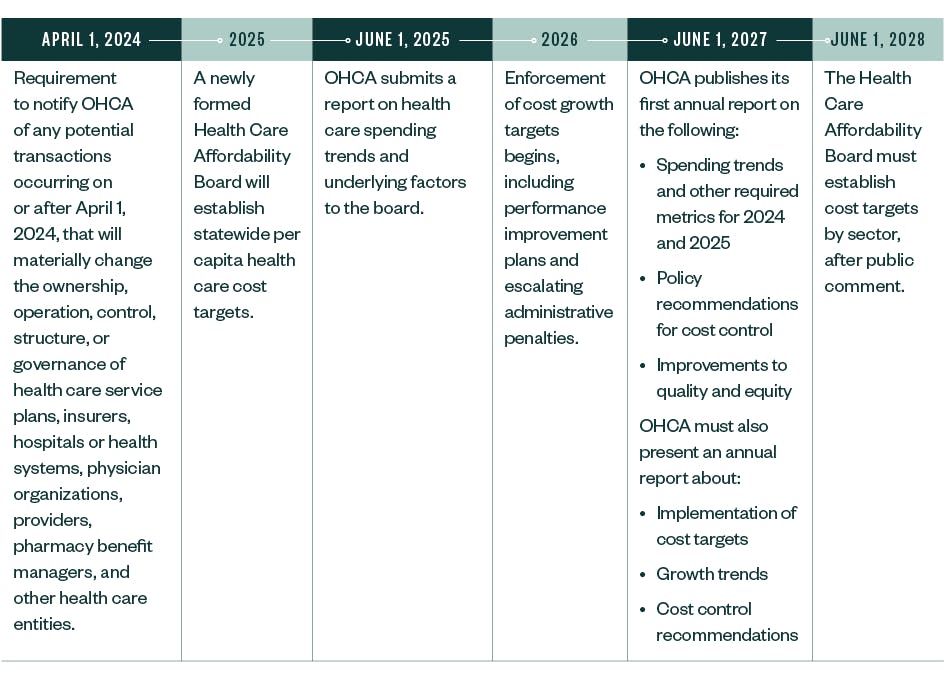
Implementation timeline for healthcare affordability initiatives
The new legislation proposes an aggressive timeline beginning in 2024.
Other impacts
SB 184 also includes a myriad of policy changes with financial impacts on healthcare providers, payers, and patients in California including, but not limited to:
- Extending the financial assistance program for the California Health Benefit Exchange, Covered California, indefinitely
- Extension of Medi-Cal eligibility, coverage, promotion of beneficiaries’ connection to a primary care provider or medical home, and expansion of Medi-Cal coverage for telehealth services, including in federally qualified health center (FQHC) and rural health clinic (RHC) settings
- Changes and funding related to mental and behavioral health programs, opioid and substance abuse treatment programs, workforce training including midwifery and community health workers, and funding for retention payments to employees and physicians
SB 184 demonstrates California’s commitment to healthcare equity by expanding Medi-Cal eligibility and covered services, and by supporting the expansion of crisis mental health services.
California healthcare providers should take advantage of the service expansions this enables and should also keep apprised of the newly created Office of Healthcare Affordability and prepare to report data as required.
Some providers may be subject to enforcement actions, and it may be advisable to conduct an internal risk assessment related to healthcare affordability and other quality metrics. Any entity that’s planning a transaction in the coming years should be aware of the increased scrutiny and reporting requirements.


