
The 2026 midterm election season officially kicked off last week with primaries beginning on March 3, 2026. As we move into the 2026 election cycle, the intersection of fiscal policy and political shifts has reached a critical juncture. Following the sweeping tax law changes of 2025, this year’s midterms will serve as a referendum on current fiscal policy and determine whether the Trump administration maintains its legislative momentum or faces a divided Congress for the next two years.
Notably, the tax policy landscape on Capitol Hill will be significantly impacted by the midterms – both before and after election day – for the remainder of Republicans’ majority control of the 119th Congress though 2026. And the yet-unknown composition of the 120th Congress will define the legislative agenda moving forward into 2027 and beyond, which includes facing another tax cliff in 2028/2029.
For now, it remains to be seen whether the razor-thin Republican majorities in Congress will hold or if the historical "midterm curse" for the party in power will return. Understanding the factors affecting decision-makers and tracking developments can help taxpayers wrangle uncertainty by assessing and planning for potential tax policy outcomes.
Balance of power
On Jan. 3, 2025, the 119th Congress convened, beginning its two-year term. Republicans currently hold a narrow majority in both chambers.
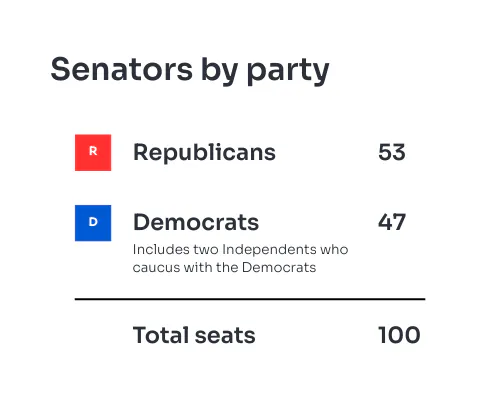
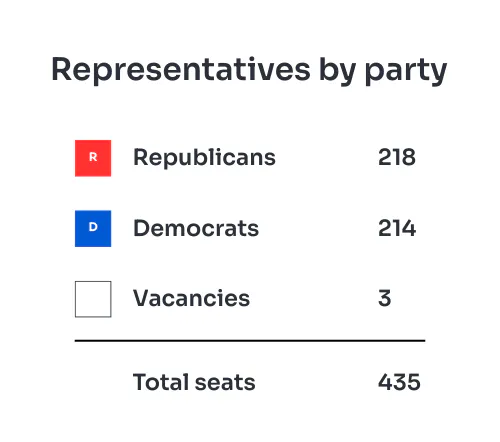
Source: Govtracks.us
Although Republicans have been working with a so-called trifecta (control of the White House, House and Senate), which enabled the enactment through budget reconciliation of the sweeping tax overhaul commonly known as the One Big Beautiful Bill Act (OBBBA) (P.L. 119-21), legislating has still proven difficult. Amidst slim vote margins, competing legislative priorities and intraparty discord, it goes to show that a unified government doesn’t always mean smooth sailing.
Midterms overview
The 2026 midterm elections will determine the composition of the 120th Congress, which will begin its two-year term on Jan. 3, 2027. To that end, on Nov. 3, 2026, voters will decide the fate of the 435 U.S. House and 35 Senate seats up for grabs.
House of Representatives
Every two years, all 435 seats in the House of Representatives are up for election. Control of the chamber requires 218 seats. Republicans' narrow one-seat majority coupled with historical trends makes the chamber the likeliest to flip in the 2026 midterm elections.
Historically, the president’s party loses seats in the midterms. Of the last 20 midterm elections, the president’s party has lost seats in 18 of them. Additionally, the party with the highest number of members heading for the exit often sees a loss of seats and even control. Currently, 35 Republicans have announced they will not seek reelection compared to 21 Democratic lawmakers announcing the same.
- Historical high: The now 56 announced departures as of March 10, 2026, exceed the 52 in 2018, marking the highest number of retirements at this point in a cycle in decades.
- Comparison to 2018: The 2018 midterms, which saw 52 departures – 34 Republicans and 18 Democrats – resulted in a loss of 40 seats for Republicans and a shift to Democratic control.
- Redistricting impact: Unprecedented mid-decade redistricting in states like Texas, California, North Carolina and Ohio has altered the "battleground" map, potentially making several formerly safe seats competitive for both parties. Some estimates on the impact, however, predict a wash.
Democrats need a net gain of just three seats to reclaim the gavel. While most estimates currently point to a Democratic flip, those predictions, while likely, are far from guaranteed.
Senate
Currently, Senate Republicans also hold a narrow majority with a 53-47 advantage, which includes two Independents who caucus with Democrats. Three seats are vacant.
This year, 35 seats are up for grabs in the upper chamber. Senators are elected to staggered six-year terms, with approximately one-third of the Senate up for re-election every two-year cycle. The rotation of senators, and the fact that two thirds of its members carry over from Congress to Congress, established the notion that the Senate is a “continuing body”— differing from the House, whose entire membership faces election every two years as noted above.
As of March 10, 2026, 10 senators – six Republicans and four Democrats — have announced that they will not seek re-election in the 2026 election cycle.
Currently, Democrats have a much narrower path to reclaiming the Senate. To flip the upper chamber, Democrats need a net gain of four seats, which at this time appears unlikely given this year’s map.
A Senate flip from Republican to Democratic control would have sweeping impacts, and not just legislatively, but particularly when it comes to Senate confirmation of nominees for vacancies in the Trump administration and federal judgeships.
Looking ahead
If Republicans retain control of both chambers, a unified government will continue until at least 2029. A unified government exists when one party controls the White House and both chambers of Congress. When this occurs, the controlling party may attempt to use budget reconciliation to pass major tax legislation, as we saw with Republicans’ OBBBA. Passing reconciliation legislation in a unified government, which requires only a simple majority vote from the controlling party, certainly expands legislative opportunity but is far from a simple endeavor. Finding consensus among party members and adhering to budgetary requirements can prove difficult. This is particularly true when the controlling party has slim majorities, as Republicans do currently, which allows individual lawmakers to exert considerable influence.
If Democrats take control of the House and/or Senate, there will be a divided government. A divided government occurs when the White House and at least one chamber of Congress is controlled by different parties. Under these circumstances, successful enactment of legislation must be a bipartisan effort. Finding bipartisan consensus, particularly in the current political climate, can be a formidable task for lawmakers, though certainly not impossible.
Baker Tilly National Tax specialists continue to monitor the situation and provide timely updates. In the meantime, stay tuned for the March 2026 Policy Pulse for an overview of what we’re watching in Washington and recent tax policy developments.

Related sections

March 2026 Policy Pulse
The information provided here is of a general nature and is not intended to address the specific circumstances of any individual or entity. In specific circumstances, the services of a professional should be sought. Tax information, if any, contained in this communication was not intended or written to be used by any person for the purpose of avoiding penalties, nor should such information be construed as an opinion upon which any person may rely. The intended recipients of this communication and any attachments are not subject to any limitation on the disclosure of the tax treatment or tax structure of any transaction or matter that is the subject of this communication and any attachments.